

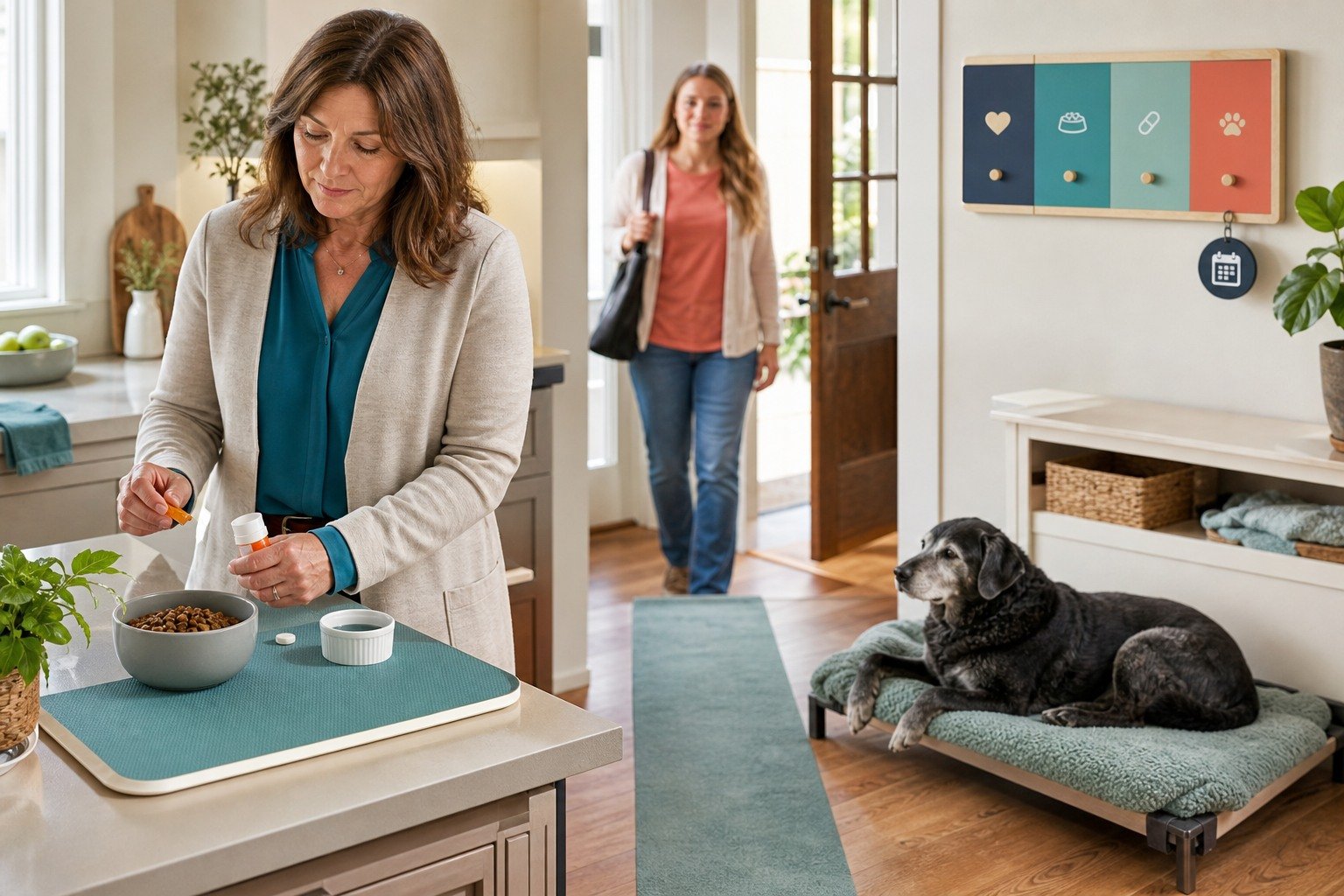
Senior care can include measured meals, medication, toileting, mobility assistance, grooming, observation, appointments, and interrupted sleep. A demanding schedule does not make attentive care impossible, but relying on memory and last-minute improvisation creates avoidable risk. Build a small system around the dog's essential needs, the tasks that can safely flex, and the signs that require veterinary contact. Assign every time-sensitive task to one person, keep one current medication and diet record, and prepare a backup for illness, travel, traffic, or work disruption. Protect the dog's pace: efficiency should reduce confusion, not turn meals, movement, handling, or toileting into a race. Senior dogs vary in pain, cognition, sensory function, frailty, chronic disease, and social preference, so the system must be individualized with the veterinary team and revised as function changes.
Short answer
Make the plan repeatable for people and comfortable for the dog
AAHA senior-care guidance emphasizes individualized assessment, caregiver communication, pain and mobility, cognition, nutrition, quality of life, and practical feasibility. A useful routine makes essential work visible and creates a reliable response when the trend changes. [1] [2]
- Record the exact dog, product or treatment, purpose, timing, and observed response.
- Use observations to support veterinary assessment, not to diagnose or treat at home.
- Protect complete nutrition, medication safety, storage, and reliable caregiver handoffs.
- Agree on measurable outcomes, a review date, and clear urgent-contact signs.
Safety first
A busy day never makes sudden decline routine
Contact a veterinarian for new appetite or thirst change, vomiting, diarrhea, house-soiling, pain, falls, weakness, confusion, breathing change, medication problems, or loss of normal interaction. Seek urgent care for collapse, seizure, inability to stand or urinate, repeated vomiting, severe pain, breathing difficulty, major trauma, or rapid deterioration.
- Do not delay care for sudden, severe, escalating, or function-limiting change.
- Do not start, stop, combine, divide, or calculate treatment from this article.
- After a possible overdose, wrong-dog dose, or toxic exposure, contact a veterinarian or animal poison service promptly.
Veterinary note
This article is educational and does not diagnose, treat, prescribe, or replace care from a licensed veterinarian. Your dog’s history, examination, diet, medications, and current signs determine what is appropriate.
Prioritize the tasks that protect health and safety
List every daily and weekly task, then identify which are time-sensitive, which can move within a veterinary-approved window, and which are optional. Medication, insulin, seizure treatment, prescription diets, wound care, and disease monitoring may have different tolerances; ask rather than guessing.
Keep a one-page current record with diet, medications, supplements, preventives, allergies, diagnoses, clinic contacts, and urgent signs. Photograph labels and update the list after every visit. Remove obsolete copies so a backup caregiver does not follow the wrong plan.
Group compatible tasks into calm routines, such as meal, medication sign-off, water and elimination check, and a brief mobility observation. Do not combine tasks when doing so changes administration instructions or makes the dog fearful.
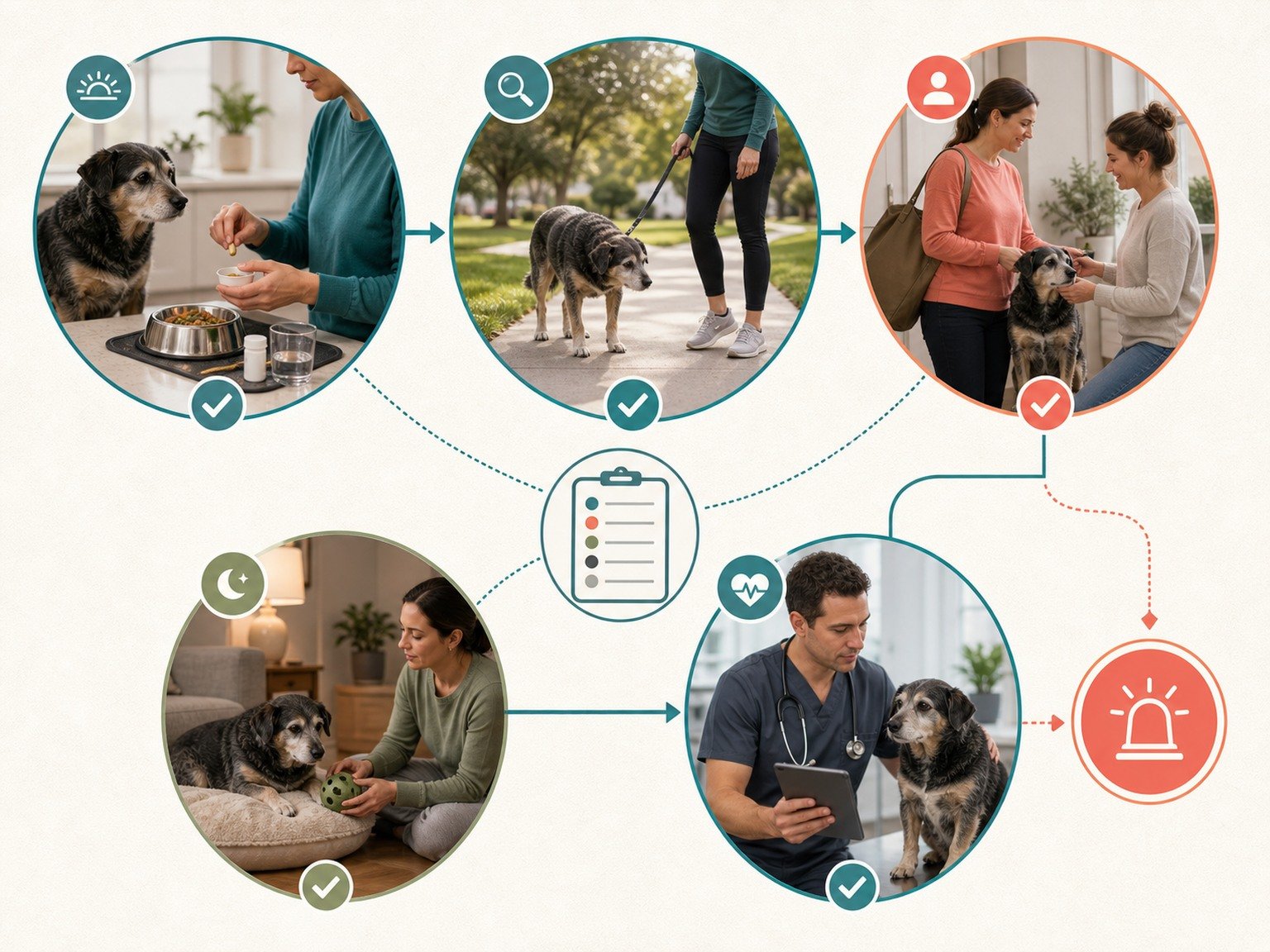
Use handoffs that identify one accountable caregiver
Assign each task to a named person and require immediate sign-off. Shared responsibility without explicit ownership can produce missed or duplicate doses, especially when schedules change unexpectedly.
Show each helper how the dog prefers to be approached, assisted, fed, walked, and rested. Include secure-entry instructions, handling cautions, mobility equipment technique, and what behavior means stop and call.
Keep backup access, transport, payment, clinic authorization, and emergency contacts current. A backup plan should work if the primary caregiver cannot answer a phone, not depend on real-time improvisation.
Protect access, rest, movement, and observation
Create nonslip routes to water, food, toileting, and rest. Place supplies where adults can reach them but animals and children cannot. Good setup reduces rushing and lets the senior dog move at a comfortable pace.
Use veterinarian-approved movement and assistance. Frailty, pain, heart or respiratory disease, and neurologic problems change what is safe; a generic exercise target or lifting method can cause harm. Geriatric rehabilitation is individualized to function and comorbidity. [3]
Record appetite, water, elimination, sleep, comfort, mobility, interaction, and recovery after activity. A short consistent record is more useful than an elaborate tracker that no caregiver can sustain.
Review the system before it fails
Set a weekly check for supplies, refills, expired instructions, calendar conflicts, and changes in the dog's ability to use the environment. Reorder early enough to allow veterinary authorization and delivery.
Bring the care record to rechecks and ask which tasks remain essential, which can be simplified, and what finding should change the plan. Nutrition and body or muscle condition may need adjustment as disease and activity change. [4]
Tell the clinic about cost, transport, handling, work, sleep, or physical limitations. Caregiver burden is measurable and can affect treatment feasibility; naming it supports a safer plan rather than signaling lack of love. [5]
Prepare for a focused veterinary conversation
Bring a concise timeline, short natural-movement or symptom videos when safe, the exact names and photographs of every food, treat, medication, and supplement label, and notes about appetite, water intake, stool, sleep, activity, comfort, and behavior. Include recent injuries, travel, boarding, diet changes, missed medication, and previous test results. A complete record helps the veterinary team separate a repeatable pattern from a single impression.
Decide in advance what you need from the visit: an urgency decision, a diagnosis plan, a nutrition review, a pain or mobility assessment, or a monitored trial. Ask what result would change the plan and what finding would rule an option out. This keeps research and product information in the right role. Evidence can shape questions and expectations, but it cannot determine what is safe for an individual dog without the history and examination.
Owner tool
Build a busy-owner senior care board
On a phone, swipe across the table to see every column.
| Checkpoint | Record | Why it helps |
|---|---|---|
| Essential | Task, timing, administrator | Prevents gaps |
| Observation | Food, sleep, movement, toilet | Finds trends |
| Handoff | Sign-off, access, emergency plan | Prevents errors |
| Review | Supplies, barriers, next visit | Keeps plan current |
Better questions, calmer next steps
Questions to ask your veterinarian
- Which tasks are time-sensitive and which can safely flex?
- Can the plan be simplified without reducing safety?
- What handling and movement are appropriate?
- Which signs require a same-day or emergency call?
- What should a backup caregiver be authorized to do?
FAQ
Do I need an elaborate app?
No. Use the simplest reliable shared record.
Can two people share medication duty?
Yes, with one-at-a-time responsibility and immediate sign-off.
Should I rush walks on workdays?
No. Follow the dog's safe pace and veterinary movement plan.
Is missing one observation important?
One gap may happen; repeated gaps can hide a trend.
Does feeling overloaded mean I am failing?
No. Ask for simplification and shared support early.
Sources
- American Animal Hospital Association: 2023 Senior Care Guidelines. Senior assessment, communication, and caregiver context.
- American Animal Hospital Association: Assessing Senior Pet Quality of Life. Repeated home observations.
- Veterinary Sciences: Rehabilitation of Geriatric Patients. Frailty, mobility, environment, and individualized rehabilitation.
- American Animal Hospital Association: Nutrition in Senior Pets. Body, muscle, energy, and nutrition review.
- Frontiers in Veterinary Science: Abbreviated Caregiver Burden Instrument. Companion-animal caregiver burden measurement.
