

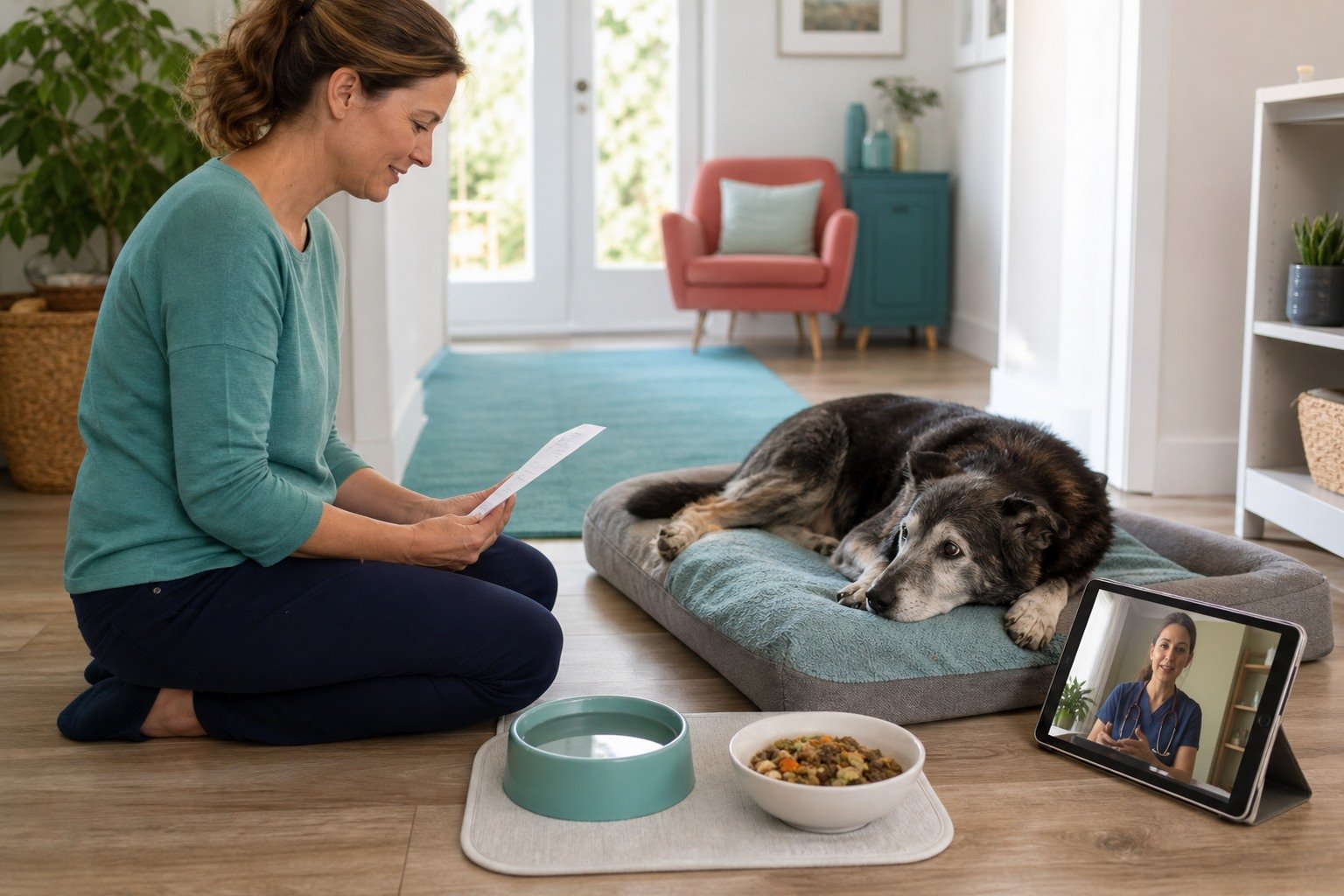
A senior dog returning home after illness may be weaker, sleepier, less coordinated, less interested in food, or more dependent on assistance than before. Those signs can reflect expected recovery, medication effects, pain, dehydration, disease progression, or a new complication; the discharge plan and veterinary team determine how they should be interpreted. Before leaving the clinic, reconcile every medication and supplement, repeat the instructions in your own words, confirm food and water guidance, define activity and toileting restrictions, and write down urgent-contact signs and the recheck date. At home, create an accessible recovery area and track function rather than guessing from one good or bad moment. Senior dogs often have multimorbidity or frailty that changes recovery risk and pace. Do not use a generic timeline, force food or exercise, or adjust treatment from online advice.
Short answer
Recovery begins with a plan you can repeat accurately at home
Senior-care guidance supports complete assessment, caregiver communication, medication review, nutrition, pain and mobility monitoring, and repeated quality-of-life observations. Frailty and concurrent disease make individual follow-up especially important. [1] [2]
- Record timing, context, intensity, recovery, and changes in daily function.
- Use observations to support veterinary assessment, not to diagnose or treat at home.
- Protect predictable routines, physical safety, rest, and access to essential resources.
- Agree on measurable outcomes, a review date, and clear urgent-contact signs.
Safety first
Know the difference between the planned recheck and urgent deterioration
Call the veterinary team for worsening appetite, vomiting, diarrhea, cough, pain, confusion, weakness, medication problems, wound change, dehydration concern, or failure to meet the discharge milestones. Seek urgent care for collapse, breathing difficulty, repeated vomiting, inability to stand or urinate, seizure, severe or escalating pain, uncontrolled bleeding, blue or very pale gums, or rapid deterioration.
- Do not delay care for sudden, severe, escalating, or function-limiting change.
- Do not start, stop, combine, divide, or calculate treatment from this article.
- Use physical separation and professional help whenever a person or animal could be injured.
Veterinary note
This article is educational and does not diagnose, treat, prescribe, or replace care from a licensed veterinarian. Your dog’s history, examination, diet, medications, and current signs determine what is appropriate.
Before discharge: reconcile the complete plan
Confirm the diagnosis or working problem, what changed in hospital, pending test results, food and water instructions, medication name and strength, amount, route, timing, duration, storage, and what to do after a missed or vomited dose.
Ask which prescriptions, supplements, preventives, and previous medicines should continue, pause, or stop. Use one current list. Do not assume that an older instruction remains valid after hospitalization.
Repeat the plan back to the clinic. Write down activity and bathing restrictions, toileting support, wound or device care, expected milestones, side effects, urgent signs, contact numbers, and exact recheck timing.
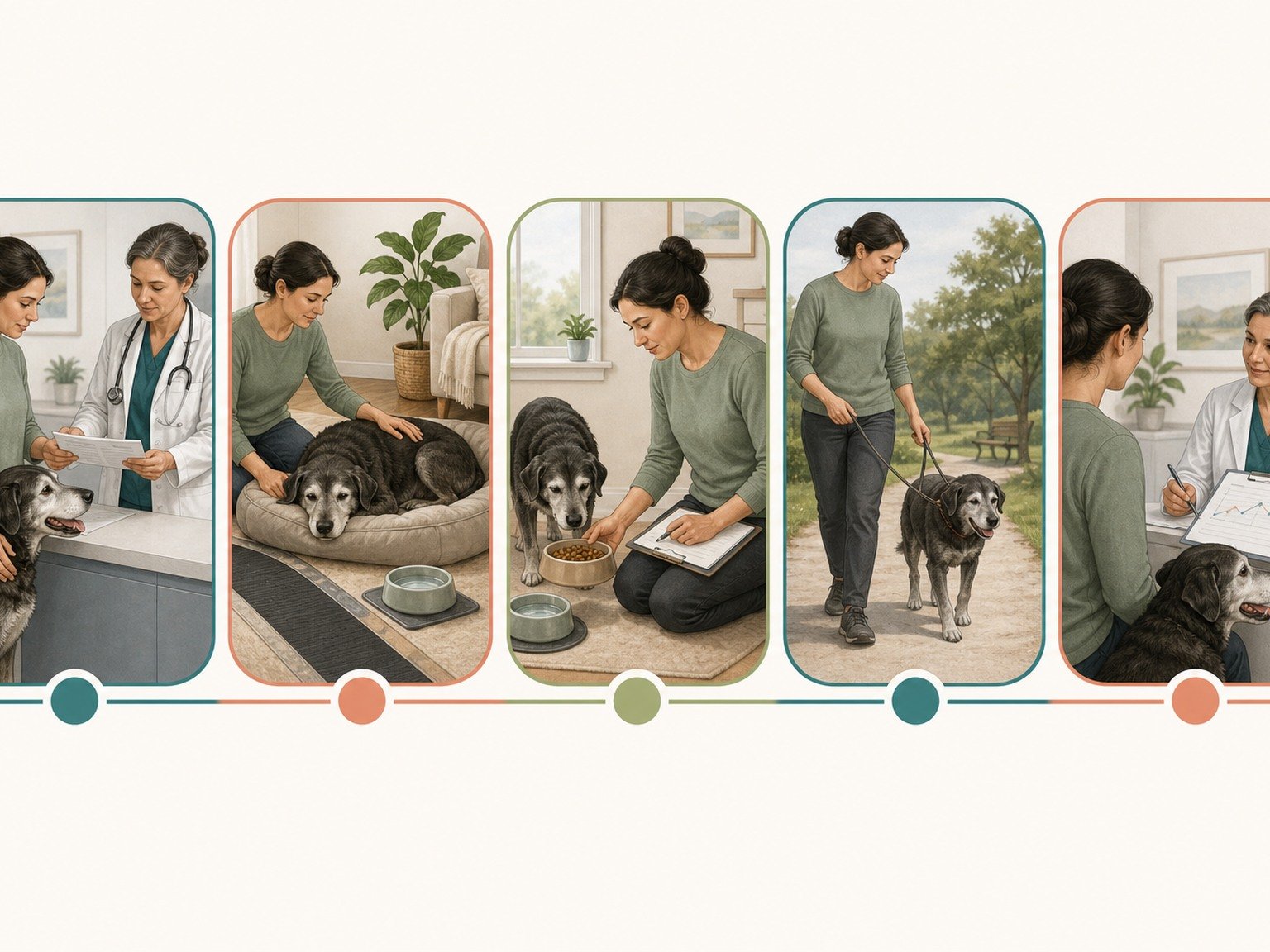
Set up an accessible recovery environment
Place a stable low bed, food, and water on a nonslip route near an easy toileting exit. Control stairs, jumping, slippery floors, heat, cold, children, and other pets according to the discharge restrictions.
Use support equipment only when the veterinary or rehabilitation team has confirmed fit and technique. Unsafe lifting or a poorly fitted sling can injure the dog and caregiver.
Protect uninterrupted rest while checking the dog at the instructed frequency. Sleep is important, but increasing difficulty waking, disorientation, breathing change, or inability to reposition may require prompt contact.
Monitor intake, output, comfort, and function
Measure offered and eaten food when practical, note water intake patterns, and record urine, stool, vomiting, coughing, wound changes, temperature only if instructed, sleep, interaction, and medication administration.
Follow the prescribed diet and feeding method. Do not force-feed, syringe water, or add rich foods, supplements, or electrolyte products without direction because aspiration, intolerance, interactions, or disease restrictions may apply.
Track weight and muscle as directed. Nutrition during aging and recovery must account for disease, appetite, digestibility, energy need, and body and muscle condition rather than age labels alone. [3]
Rebuild movement only within the veterinary plan
Follow restrictions for leash walks, stairs, jumping, rehabilitation, and return to activity. Short controlled movement may support toileting and function, but the safe amount depends on the illness, procedure, pain, cardiopulmonary status, neurologic function, and frailty.
Record assistance needed to rise, stand, walk, turn, eat, drink, and toilet, plus recovery after activity. A video can help the clinic if recording does not delay care or create risk.
Attend the recheck even when improvement seems obvious. The veterinary team may need to examine the dog, review laboratory trends, change treatment, assess pain and muscle, or investigate a stalled or uneven recovery. No single timeline fits every senior dog. [4] [5]
Prepare for a focused veterinary conversation
Bring a concise timeline, short natural-movement or symptom videos when safe, the exact names and photographs of every food, treat, medication, and supplement label, and notes about appetite, water intake, stool, sleep, activity, comfort, and behavior. Include recent injuries, travel, boarding, diet changes, missed medication, and previous test results. A complete record helps the veterinary team separate a repeatable pattern from a single impression.
Decide in advance what you need from the visit: an urgency decision, a diagnosis plan, a nutrition review, a pain or mobility assessment, or a monitored trial. Ask what result would change the plan and what finding would rule an option out. This keeps research and product information in the right role. Evidence can shape questions and expectations, but it cannot determine what is safe for an individual dog without the history and examination.
Owner tool
Build a senior recovery record
On a phone, swipe across the table to see every column.
| Checkpoint | Record | Why it helps |
|---|---|---|
| Plan | Medicines, food, restrictions, recheck | Prevents error |
| Intake | Food, water, weight | Tracks support |
| Function | Rise, walk, toilet, rest | Measures trend |
| Safety | Urgent signs and contacts | Speeds response |
Better questions, calmer next steps
Questions to ask your veterinarian
- Which changes are expected and which are urgent?
- Can we reconcile every medicine and supplement?
- What food, water, and activity rules apply?
- How should I assist movement safely?
- What milestones and recheck tests will guide the next step?
FAQ
How long should recovery take?
It depends on illness, treatment, frailty, and concurrent disease.
Should I let my senior dog sleep all day?
Provide rest, but follow monitoring instructions and report concerning responsiveness or function changes.
Can I add a recovery supplement?
Not without veterinary review of purpose, evidence, and interactions.
Should I force food or water?
No. Contact the veterinary team for safe guidance.
Can I skip the recheck if my dog looks better?
No. Confirm any change to the follow-up plan with the clinic.
Sources
- American Animal Hospital Association: 2023 Senior Care Guidelines. Senior assessment, communication, and follow-up.
- Frontiers in Veterinary Science: Canine Geriatric Syndrome. Frailty and multimorbidity in senior dogs.
- Animals: Nutritional Needs of Aging Dogs. Nutrition, body condition, muscle, and disease context.
- Veterinary Sciences: Rehabilitation of Geriatric Patients. Safe mobility and individualized rehabilitation.
- American Animal Hospital Association: Assessing Senior Pet Quality of Life. Repeated observation of comfort and function.
