


Chronic or recurrent vomiting, diarrhea, appetite change, weight loss, or other gastrointestinal signs are not one disease. They can reflect parasites, dietary response, chronic inflammatory enteropathy, pancreatic or liver disease, endocrine illness, infection, obstruction, cancer, medication effects, or problems outside the digestive tract. The 2026 ACVIM-endorsed chronic inflammatory enteropathy statement emphasizes detailed diet history, appropriate diagnostic evaluation, structured dietary trials, validated clinical scoring, and individualized treatment. Owners can make care safer and more interpretable by following one written plan, measuring food, preventing unplanned exposures, recording signs and function, reconciling medication, collecting samples correctly, and attending reassessment. This is management support, not a home diagnostic or treatment protocol.
Short answer
Consistency turns daily observations into useful clinical evidence
Current ACVIM guidance treats canine chronic inflammatory enteropathy as a multifactorial group of disorders and recommends detailed diet history, diagnostic evaluation, exclusive therapeutic diet trials, and repeated clinical assessment. Owner records help, but they do not determine the diagnosis or treatment alone. [1]
- Record the dog's baseline, current routine, exact diet and products, and any recent change.
- Use observations to support veterinary assessment, not to diagnose or create treatment at home.
- Keep every household member working from the same written plan and product list.
- Agree on measurable outcomes, a review date, and clear urgent-contact signs.
Safety first
Blood, dehydration, severe pain, repeated vomiting, collapse, or rapid decline needs urgent assessment
Contact a veterinarian promptly for worsening diarrhea, recurrent vomiting, appetite loss, weight or muscle loss, fever, pain, swelling, medication problems, or relapse. Seek urgent care for collapse, repeated unproductive retching, severe weakness, black or bloody stool, breathing difficulty, inability to keep water down, suspected obstruction, or rapid deterioration.
- Do not delay care for sudden, severe, escalating, or function-limiting signs.
- Do not start, stop, combine, divide, or calculate treatment from this article.
- Preserve exact labels, lot information, exposure details, and a concise timeline.
Veterinary note
This article is educational and does not diagnose, treat, prescribe, or replace care from a licensed veterinarian. Your dog’s history, examination, diet, medications, and current signs determine what is appropriate.
Keep the diagnostic question open
Chronic inflammatory enteropathy describes persistent or recurrent gastrointestinal signs with complex interactions among host immunity, genetics, diet, microbiota, and environment. It should not be used as a casual synonym for every sensitive stomach or for human inflammatory bowel disease. [1]
Bring the full timeline, prior tests, treatments, response, relapse, and exact diet history. Include food, treats, chews, flavored medications, supplements, scavenging, travel, boarding, stress, water sources, and other animals with signs. [3]
Ask which differentials remain, what each test can change, and whether weight, muscle, albumin, cobalamin, folate, pancreatic markers, imaging, endoscopy, or biopsy is relevant. Not every dog needs every test. [4]
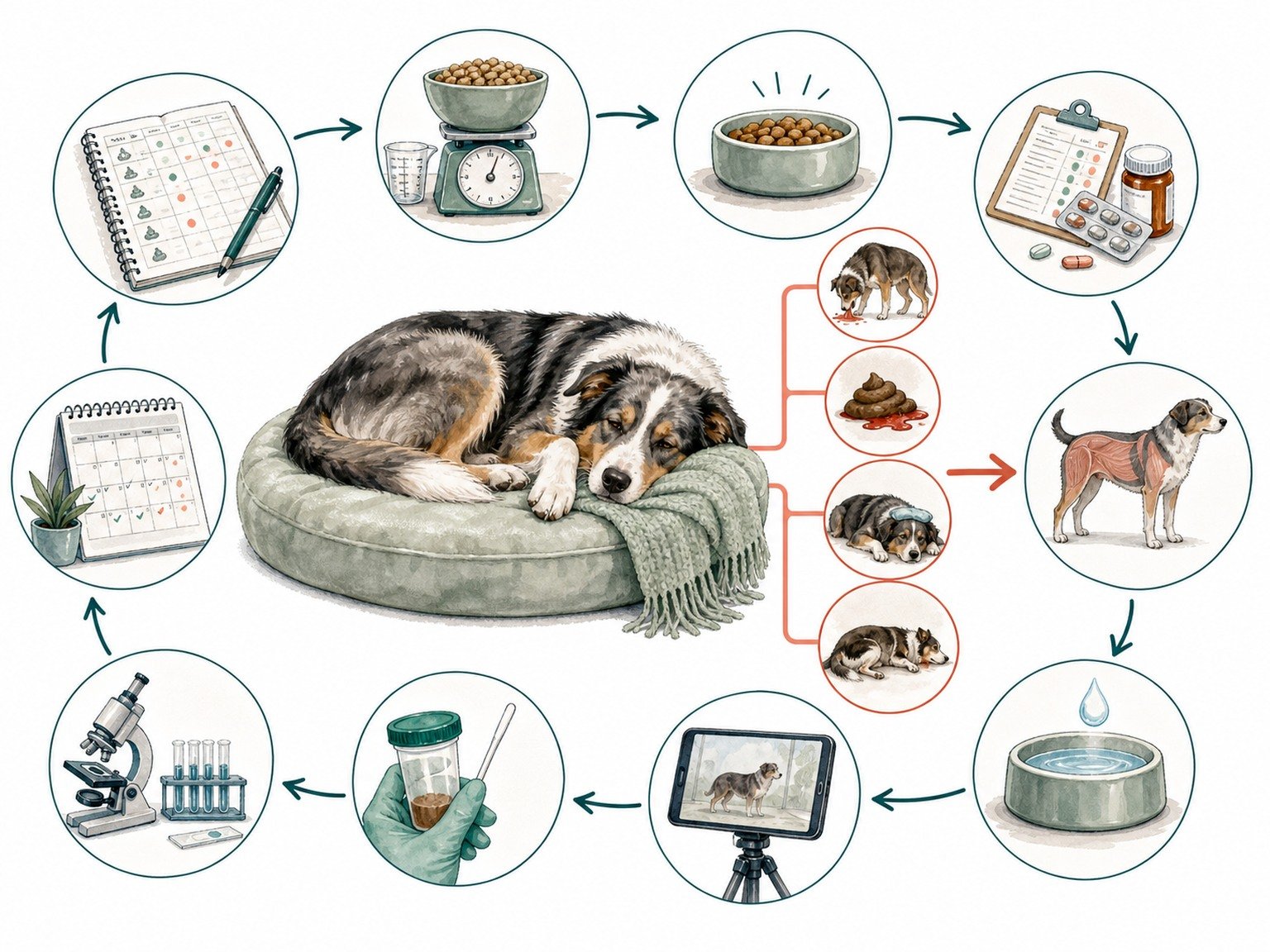
Run dietary trials as controlled clinical interventions
The ACVIM statement supports exclusive therapeutic diet trials selected from detailed history and findings. Exclusive means the approved diet and permitted administration plan, without unplanned treats, chews, table food, flavored products, or access to another pet's bowl. [1]
Measure the food and record daily intake. If the dog refuses food, loses weight, vomits, or deteriorates, contact the veterinary team rather than forcing the trial or adding ingredients that make it uninterpretable.
Do not switch among foods because of one stool, online advice, or package marketing. The clinician decides trial category, duration, transition, response criteria, and whether additional trials are appropriate.
Use a compact record that the household can sustain
Record stool frequency and character, vomiting, appetite, weight, activity, discomfort, urgency, accidents, medications, diet adherence, and unusual exposures. A short daily record is more useful than a detailed diary abandoned after three days.
Use the same definitions and one shared calendar. Mark normal days as well as difficult days so the record does not exaggerate disease. Safe photographs or video may help document gait, posture, retching, regurgitation, or nighttime episodes.
Validated clinical scores such as CCECAI may be used by veterinary teams, but owners should not self-stage disease from an online calculator. Ask which observations the clinic wants and how often to report them. [2]
Plan for medications, relapse, and caregiver load
Keep exact medication and supplement names, strengths, amounts, times, missed doses, administration method, and suspected adverse effects. Do not stop corticosteroids, immunomodulators, antibiotics, or other prescribed treatment abruptly unless directed.
Agree on what counts as expected variation, inadequate response, relapse, or emergency. Ask who to contact after hours, what sample or video to collect, and which changes should trigger testing rather than another empiric product. [5]
Chronic care can affect sleep, work, finances, travel, and stress. Tell the veterinary team when the plan is not feasible. A simpler coordinated plan that can be followed is more useful than an idealized plan that repeatedly breaks down.
Prepare for a focused veterinary conversation
Bring a concise timeline, short natural-movement or symptom videos when safe, the exact names and photographs of every food, treat, medication, and supplement label, and notes about appetite, water intake, stool, sleep, activity, comfort, and behavior. Include recent injuries, travel, boarding, diet changes, missed medication, and previous test results. A complete record helps the veterinary team separate a repeatable pattern from a single impression.
Decide in advance what you need from the visit: an urgency decision, a diagnosis plan, a nutrition review, a pain or mobility assessment, or a monitored trial. Ask what result would change the plan and what finding would rule an option out. This keeps research and product information in the right role. Evidence can shape questions and expectations, but it cannot determine what is safe for an individual dog without the history and examination.
Owner tool
Build a chronic digestive care record
On a phone, swipe across the table to see every column.
| Checkpoint | Record | Why it helps |
|---|---|---|
| Signs | Stool, vomiting, appetite, pain | Shows severity |
| Diet | Exact food, amount, adherence, exposure | Tests response |
| Treatment | Drug, time, missed dose, effect | Supports safety |
| Trend | Weight, muscle, function, review | Guides next step |
Better questions, calmer next steps
Questions to ask your veterinarian
- Which diagnoses and red flags remain?
- What exact diet trial and adherence rules apply?
- Which observations or tests define response?
- What medication change requires a call?
- When is reassessment or referral needed?
FAQ
Is chronic diarrhea always food allergy?
No. Many causes and mechanisms are possible.
Can I add treats during a diet trial?
Only items explicitly allowed by the veterinary plan.
Should I change food after one bad stool?
Not without guidance and context.
Can a symptom score diagnose the disease?
No. It supports monitoring.
What if the plan is too hard to follow?
Tell the veterinary team so it can be simplified safely.
Sources
- Journal of Veterinary Internal Medicine: ACVIM Guidelines for Chronic Inflammatory Enteropathy in Dogs. Diagnosis, diet trials, monitoring, and treatment.
- Journal of Veterinary Internal Medicine: Canine Chronic Enteropathy Clinical Activity Index. Clinical scoring in veterinary monitoring.
- World Small Animal Veterinary Association: Global Nutrition Guidelines. Diet history and nutrition assessment.
- Merck Veterinary Manual: Introduction to Digestive Disorders of Dogs. Digestive signs and diagnostic context.
- American College of Veterinary Internal Medicine: ACVIM Endorsed Statements. Specialty consensus framework.
