


Aging dogs can develop valve disease, heart-muscle disease, rhythm disorders, pulmonary hypertension, and other cardiovascular problems, but age alone does not diagnose heart disease. A murmur is a sound, heart enlargement is a structural finding, arrhythmia is a rhythm abnormality, and heart failure is a clinical syndrome; the terms should not be used interchangeably. Some dogs with heart disease have no signs for years, while coughing, reduced stamina, fainting, restlessness, abdominal enlargement, or faster breathing can also arise from respiratory, pain, metabolic, or other disease. Current ACVIM guidance uses defined stages and diagnostic criteria for common myxomatous mitral valve disease. Owners can contribute careful observations, especially sleeping respiratory patterns, without attempting to interpret sounds, adjust medication, or diagnose failure at home.
Short answer
A cardiac finding needs a diagnosis, stage, and trend
ACVIM guidance distinguishes dogs at risk, dogs with structural disease but no heart-failure signs, and dogs with current or previous failure. Examination, chest imaging, echocardiography, and other tests are chosen to answer specific questions rather than confirm age-related decline. [1] [2]
- Record observable changes, context, frequency, severity, recovery, and whole-dog function with dates.
- Use this guide to prepare a veterinary conversation, not to diagnose or choose treatment alone.
- Bring every medication, supplement, diet, prior result, and safe home video to the appointment.
- Agree on the next decision, measurable outcomes, reassessment timing, and urgent-contact signs.
Safety first
Breathing difficulty, collapse, or blue-gray gums is an emergency
Seek emergency care for labored or open-mouth breathing, blue-gray or very pale gums, collapse, severe weakness, inability to rest, or rapidly increasing abdominal size with distress. Contact the veterinarian promptly for new coughing, fainting, reduced stamina, nighttime restlessness, appetite loss, or a sustained change in sleeping breathing rate.
- Do not delay care because a change seems like normal aging, stress, or a minor accident.
- Do not start, stop, combine, or calculate medication or treatment from this article.
- Protect comfort and safety while arranging appropriate veterinary evaluation.
Veterinary note
This article is educational and does not diagnose, treat, prescribe, or replace care from a licensed veterinarian. Your dog’s history, examination, diet, medications, and current signs determine what is appropriate.
Separate a murmur from a diagnosis
A veterinarian grades and locates a murmur and evaluates rhythm, pulse quality, lung sounds, breathing, mucous membranes, and overall condition. Murmur loudness alone does not reveal the exact disease, chamber size, or risk of heart failure.
Myxomatous mitral valve disease is common in older small dogs, but large dogs and other breeds can have different valve, muscle, congenital, rhythm, or systemic causes. ACVIM staging uses evidence about structural change and clinical signs to guide decisions. [1]
Heart failure is not synonymous with heart disease. Merck explains that compensated disease may cause structural change without failure signs, while congestive failure involves clinically important fluid accumulation. [2]
Understand what common tests contribute
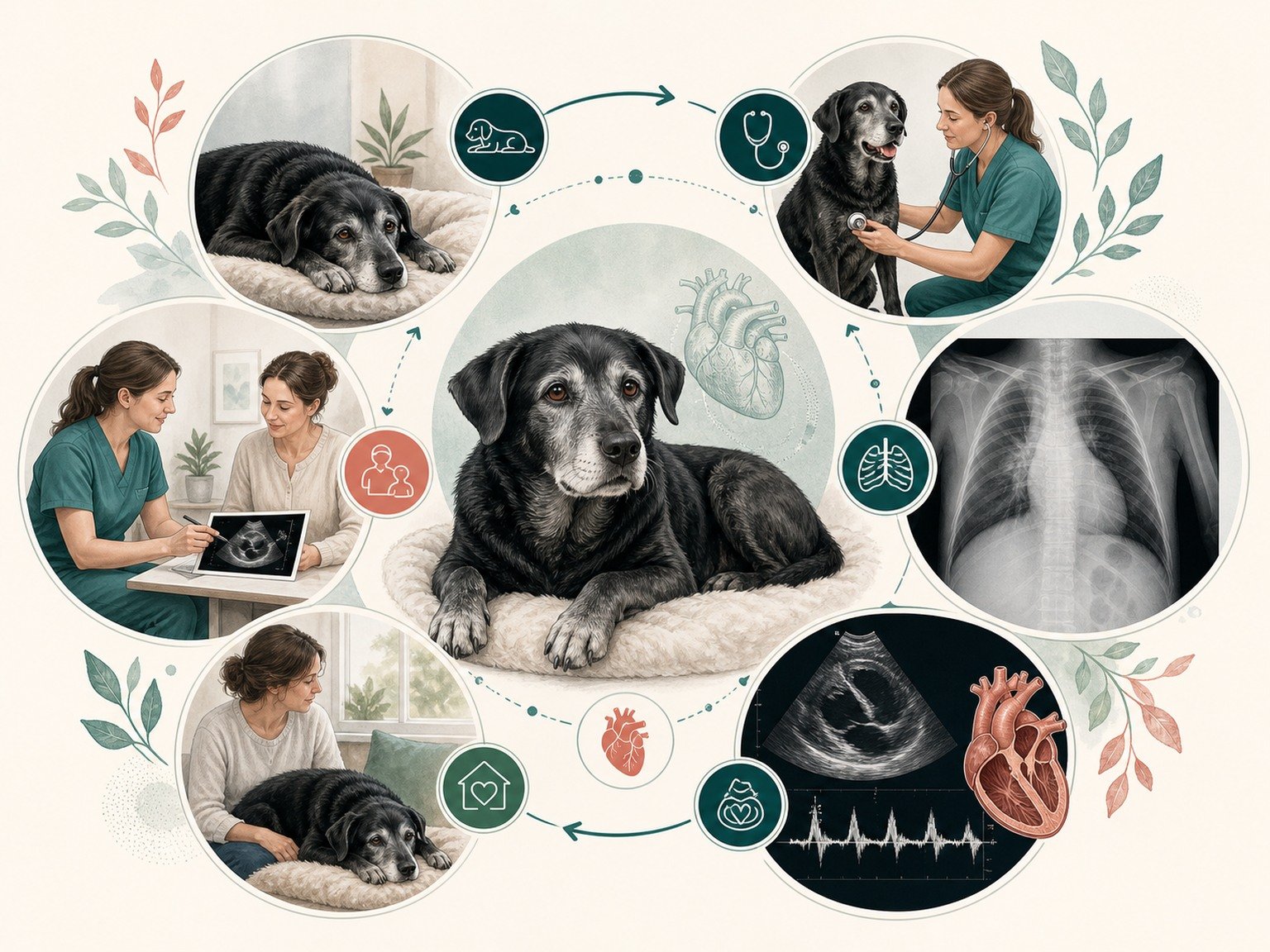
Thoracic radiographs evaluate heart silhouette, vessels, lungs, and evidence of congestion. Echocardiography assesses anatomy, chamber dimensions, valve motion, flow, and function. Electrocardiography records rhythm; blood pressure and biomarkers answer different questions.
No test should be interpreted in isolation. Body size, breed, respiratory disease, hydration, stress, kidney function, medication, and image quality can affect interpretation. Ask what the test is meant to distinguish and whether referral changes the decision.
AAHA's unhealthy-senior framework lists cardiac and respiratory examination plus individualized radiographs, echocardiography, blood pressure, and biomarkers when clinically appropriate. It does not recommend every cardiac test for every dog. [3]
Use home observations without creating a diagnosis
Record cough timing, activity, appetite, sleep, restlessness, fainting-like events, recovery, and medication administration. A safe natural video can help distinguish coughing, gagging, reverse sneezing, weakness, and collapse, but never provoke exercise or distress for evidence.
Ask the veterinarian whether and how to count sleeping respiratory rate for this dog. Count only when truly asleep or quietly resting, use the clinic's method, and report the trend and effort rather than changing medication from a generic online threshold.
Pulmonary hypertension and respiratory disease can overlap with cardiac signs and require specialized interpretation. ACVIM consensus guidance emphasizes classification by underlying mechanism rather than treating one pressure estimate as a complete diagnosis. [4]
Keep treatment stage-specific and monitored
Treatment depends on diagnosis, stage, clinical signs, kidney function, blood pressure, electrolytes, concurrent disease, and response. A medication appropriate after documented enlargement or heart failure may not be appropriate for a dog with a murmur alone.
Do not change diuretics, heart medication, salt, water, supplements, or exercise without veterinary direction. Extra doses can cause dehydration, kidney injury, electrolyte disturbance, low blood pressure, or delayed treatment of another cause.
Keep a current medication list, refill plan, recheck schedule, and emergency route. Ask which outcome signals control, progression, adverse effect, or need for cardiology referral. Senior screening helps establish trends but remains individualized. Record who to call after hours and where the nearest emergency hospital is before breathing or collapse signs occur. [5]
Prepare for a focused veterinary conversation
Bring a concise timeline, short natural-movement or symptom videos when safe, the exact names and photographs of every food, treat, medication, and supplement label, and notes about appetite, water intake, stool, sleep, activity, comfort, and behavior. Include recent injuries, travel, boarding, diet changes, missed medication, and previous test results. A complete record helps the veterinary team separate a repeatable pattern from a single impression.
Decide in advance what you need from the visit: an urgency decision, a diagnosis plan, a nutrition review, a pain or mobility assessment, or a monitored trial. Ask what result would change the plan and what finding would rule an option out. This keeps research and product information in the right role. Evidence can shape questions and expectations, but it cannot determine what is safe for an individual dog without the history and examination.
Owner tool
Prepare a cardiac observation record
On a phone, swipe across the table to see every column.
| Checkpoint | Record | Why it helps |
|---|---|---|
| Finding | Murmur, rhythm, imaging | Defines disease |
| Home | Breathing, cough, stamina, sleep | Shows function |
| Safety | Collapse, effort, gum color | Sets urgency |
| Plan | Drug, test, recheck, referral | Coordinates care |
Better questions, calmer next steps
Questions to ask your veterinarian
- What diagnosis causes this finding?
- What stage and structural changes apply?
- Which test would change treatment?
- How should breathing be monitored?
- Which sign requires emergency care?
FAQ
Does a murmur mean heart failure?
No.
Does coughing always come from the heart?
No.
Can I count breathing at home?
Yes, if the veterinarian provides the method and response plan.
Should every murmur be treated?
No. Treatment depends on diagnosis and stage.
Can I adjust a diuretic myself?
No.
Sources
- Journal of Veterinary Internal Medicine: ACVIM MMVD Consensus Guidelines. Diagnosis, staging, evidence strength, and treatment boundaries.
- Merck Veterinary Manual: Heart Failure in Dogs. Distinction between heart disease and heart failure.
- American Animal Hospital Association: Evaluating the Unhealthy Senior Pet. Senior cardiac and respiratory diagnostic framework.
- Journal of Veterinary Internal Medicine: ACVIM Pulmonary Hypertension Consensus. Differential mechanisms and specialist evaluation.
- American Animal Hospital Association: Senior Diagnostic Tests. Individualized senior cardiac screening context.
