


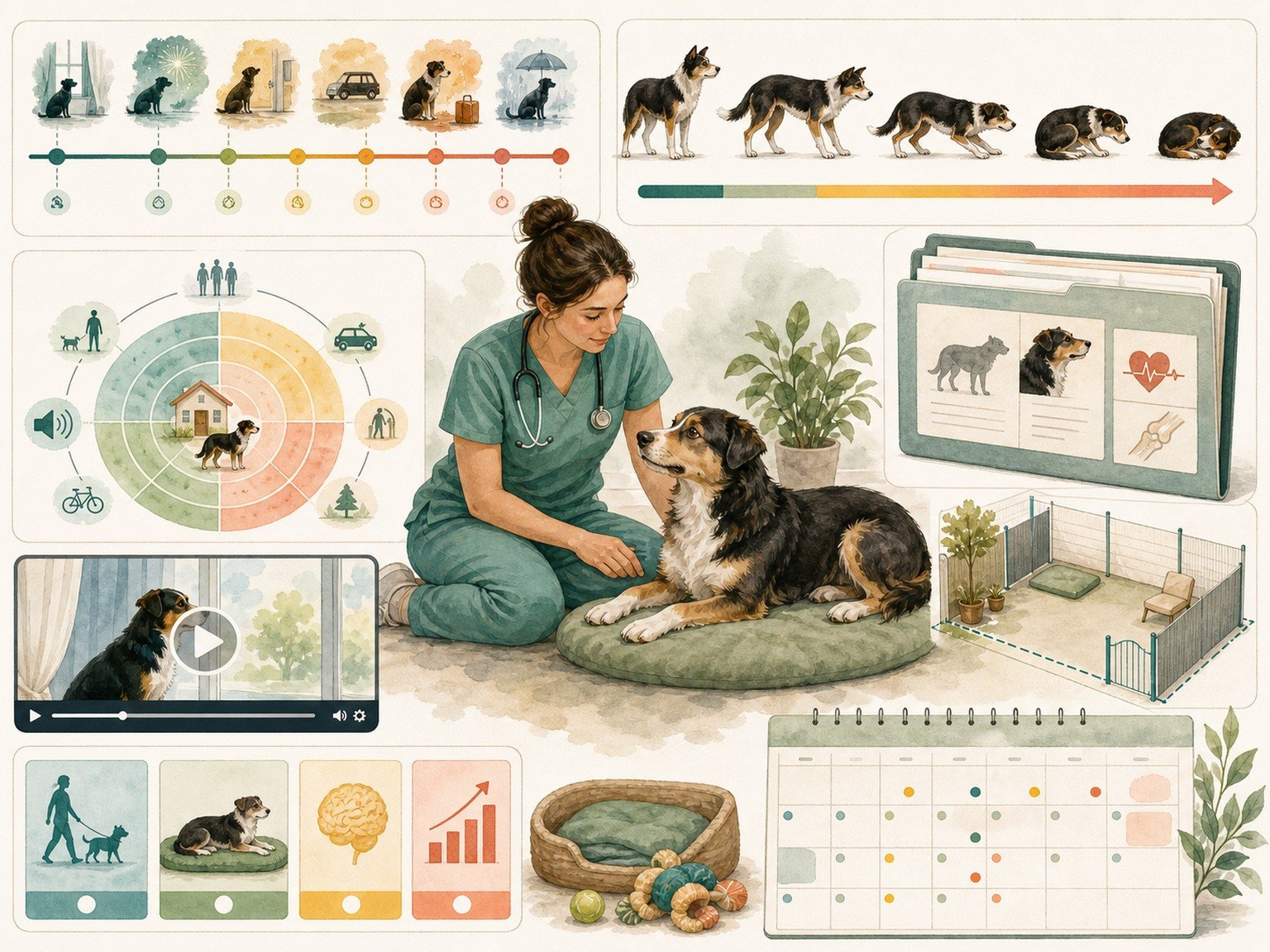
Anxiety is an emotional state, not one behavior or one diagnosis. Panting, pacing, hiding, freezing, scanning, barking, destructive behavior, escape attempts, elimination, aggression, appetite changes, and inability to settle can have different motivations and medical contributors. Prepare a timeline that describes the trigger, context, distance or intensity, earliest body-language changes, peak response, recovery, and normal behavior between episodes. Include pain, gastrointestinal, skin, neurologic, endocrine, sensory, cognitive, medication, sleep, and life-change history. Ask what diagnosis or differential categories fit, how immediate safety and welfare will be protected, and how management, behavior modification, medication, and referral may work together. This guide is a conversation tool, not a diagnosis or training protocol.
Short answer
Bring observable behavior and context, not only the label anxious
Veterinary behavior guidance begins with management and safety, medical assessment, precise behavior history, humane modification, and medication when indicated. Avoid provoking an episode for proof; a natural home video, timeline, and recovery description are more useful and safer. [1] [2]
- Record the trigger, distance or intensity, body language, recovery, and whole-dog function with dates.
- Use research to prepare a veterinary conversation, not to diagnose or run a treatment protocol alone.
- Bring every medication, supplement, diet, prior plan, and safe home video to the appointment.
- Agree on safety rules, measurable outcomes, reassessment timing, and urgent-contact signs.
Safety first
Aggression, self-injury, escape risk, or sudden behavior change needs prompt help
Contact a veterinarian promptly for sudden behavior change, severe panic, inability to eat or rest, self-injury, destructive escape attempts, aggression, disorientation, pain signs, or major functional decline. Use distance and barriers for immediate safety. Seek emergency help after toxin exposure, trauma, collapse, seizure, breathing difficulty, or rapid neurologic change.
- Do not force exposure, punish fear, or prevent escape to make a dog appear calm.
- Do not start, stop, combine, or calculate medication or treatment from this article.
- Protect people and animals with distance, barriers, supervision, and qualified help.
Veterinary note
This article is educational and does not diagnose, treat, prescribe, or replace care from a licensed veterinarian. Your dog’s history, examination, diet, medications, and current signs determine what is appropriate.
Document behavior before the appointment
Record the setting, people and animals present, sound, movement, distance, duration, restraint, weather only as context, and events immediately before the response. Describe ears, eyes, mouth, posture, tail, movement, vocalization, appetite, and recovery.
Capture short natural videos only when safe. Do not recreate a trigger, corner the dog, remove an escape route, or test tolerance. Rehearsed fear can worsen learning and increase bite or escape risk. [1]
Bring daily routine, sleep, exercise, social contact, diet, medication, supplements, prior training methods, adverse experiences, and previous response. Note whether the problem is new, progressive, situation-specific, or present across contexts.
Ask about medical contributors and diagnosis
Ask which medical problems can cause or amplify the signs and what examination or testing is appropriate. Pain, sensory loss, cognitive change, neurologic disease, endocrine illness, skin discomfort, and medication effects can alter behavior. [2]
Ask whether the working diagnosis is separation-related distress, noise aversion, situational fear, generalized anxiety, panic, compulsive behavior, aggression with a specific motivation, or another pattern. Labels affect safety and treatment planning.
Ask what remains uncertain and whether referral to a board-certified veterinary behaviorist is indicated. Complex aggression, multiple diagnoses, poor response, severe welfare compromise, and medication complexity often justify specialty involvement. [3]
Ask how management and treatment will work
Management reduces exposure and rehearsal while protecting welfare and safety. Ask about distance, visual or sound barriers, predictable routines, safe confinement only when the dog tolerates it, visitor plans, walking routes, and emergency handling.
Behavior modification should change emotional response gradually, not suppress warning signals. Ask what foundation skills are needed, how low the starting intensity should be, what body language means stop, and how progress will be advanced. [4]
If medication is discussed, ask about its role, onset expectations, interaction review, baseline testing, adverse effects, administration, monitoring, and how it supports learning. Medication should be integrated with management and modification rather than treated as a stand-alone cure. [5]
Ask about measurement, setbacks, and long-term care
Choose outcomes tied to welfare and function: recovery time, ability to eat, sleep, settle, remain under threshold, tolerate an unavoidable event, or complete a safe daily routine. Frequency alone can mislead when intensity or exposure changes.
Ask what setback is expected, what indicates sensitization, and when the plan should pause. Moving too quickly can provoke fear and undermine counter-conditioning; more exposure is not always therapeutic exposure. [1]
Confirm follow-up timing, after-hours contact, bite or escape documentation, and who coordinates the team. Preserve one current written plan so family, trainer, veterinarian, and specialist do not apply conflicting methods.
Keep the care and training record consistent
Before leaving the consultation, repeat the safety and treatment plan in your own words. Confirm which family member records events, how bite or escape incidents should be documented, who receives updates, and what after-hours pathway applies. A single shared record prevents family members, trainers, and clinics from acting on different versions of the dog's history.
Prepare for a focused veterinary conversation
Bring a concise timeline, short natural-movement or symptom videos when safe, the exact names and photographs of every food, treat, medication, and supplement label, and notes about appetite, water intake, stool, sleep, activity, comfort, and behavior. Include recent injuries, travel, boarding, diet changes, missed medication, and previous test results. A complete record helps the veterinary team separate a repeatable pattern from a single impression.
Decide in advance what you need from the visit: an urgency decision, a diagnosis plan, a nutrition review, a pain or mobility assessment, or a monitored trial. Ask what result would change the plan and what finding would rule an option out. This keeps research and product information in the right role. Evidence can shape questions and expectations, but it cannot determine what is safe for an individual dog without the history and examination.
Owner tool
Prepare an anxiety consultation brief
On a phone, swipe across the table to see every column.
| Checkpoint | Record | Why it helps |
|---|---|---|
| Trigger | Context, distance, intensity | Defines pattern |
| Response | Body language, function, recovery | Shows severity |
| Health | Pain, sleep, drugs, medical change | Finds contributors |
| Plan | Safety, goal, measure, recheck | Coordinates care |
Better questions, calmer next steps
Questions to ask your veterinarian
- Which medical causes need evaluation?
- What behavior diagnosis best fits and what remains uncertain?
- How should we prevent unsafe rehearsal now?
- What roles do behavior work and medication have?
- What sign requires urgent help or referral?
FAQ
Should I trigger the behavior for a video?
No. Record only naturally occurring events when safe.
Can anxiety look like aggression?
Fear and anxiety can contribute, but aggression requires a specific risk assessment.
Will more exposure help?
Only carefully controlled exposure below the dog's fear threshold.
When is referral appropriate?
For severe, complex, risky, or poorly responsive cases.
Should every anxious dog take medication?
No. The decision is individual.
Sources
- Merck Veterinary Manual: Treatment of Behavior Problems in Animals. Management, modification, medication, safety, and medical evaluation.
- American Animal Hospital Association: Canine Life Stage Behavior Guidance. Behavior assessment, veterinary role, and low-stress care.
- American College of Veterinary Behaviorists: Resources for Animal Owners. Specialist referral and owner resources.
- Merck Veterinary Manual: Behavior Modification in Dogs. Humane methods, desensitization, and counter-conditioning.
- American Animal Hospital Association: Pharmacological Intervention. Integrated medication, risk, monitoring, and interactions.
