

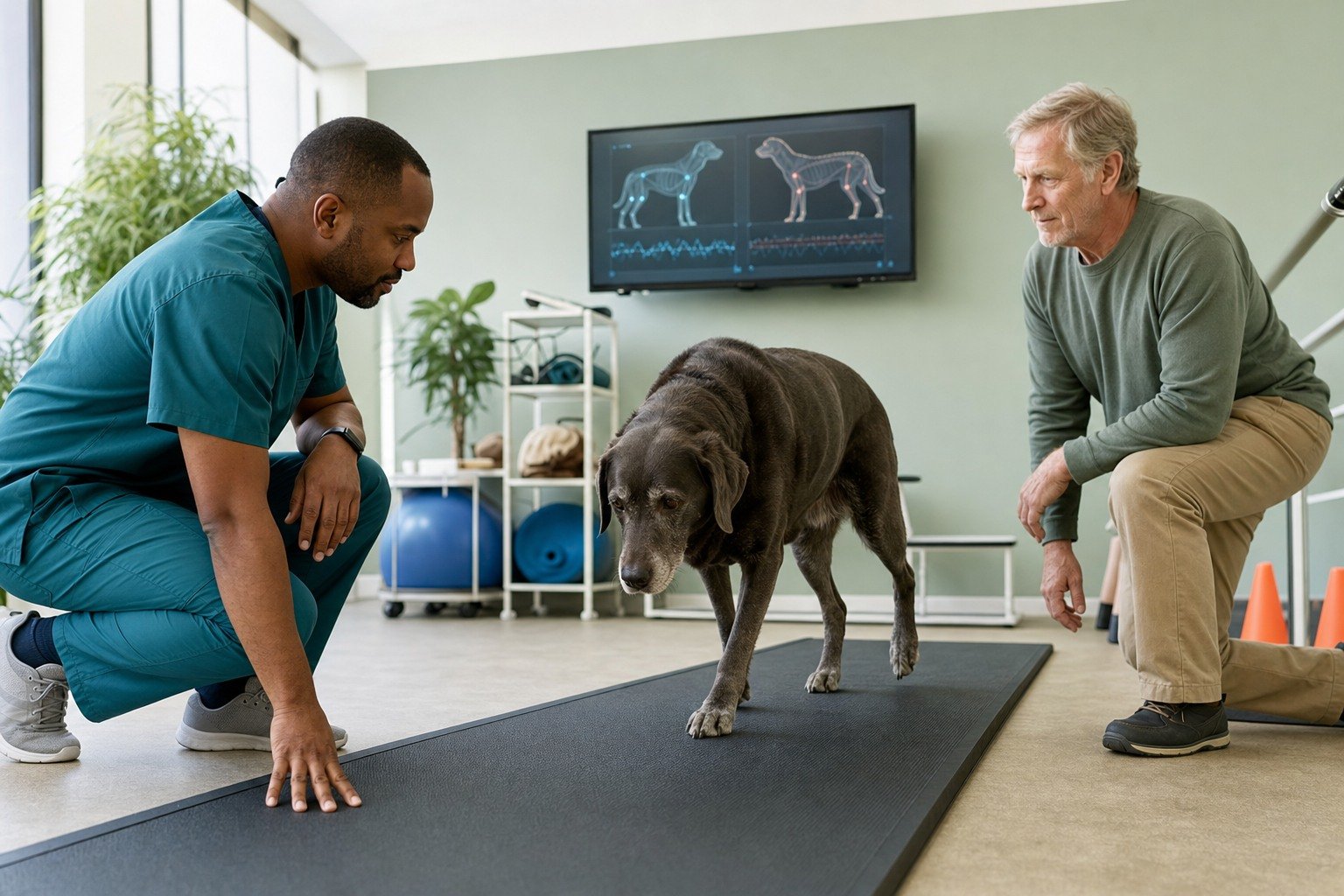
Canine osteoarthritis is a progressive, whole-joint disorder involving cartilage, bone, synovium, supporting tissues, inflammation, and pain. It may develop after joint instability, developmental disease, injury, abnormal conformation, or other joint damage, and age can make accumulated change more visible without being the single cause. Signs often emerge as changes in function: slower rising, reluctance on stairs, shorter walks, altered posture, slipping, sleep disruption, reduced play, or behavior change. Diagnosis uses history, orthopedic and neurologic examination, and imaging when indicated. Management is individualized and commonly multimodal, with repeated assessment of pain, function, body condition, adverse effects, and quality of life. This article does not provide a diagnosis, drug, dose, supplement, exercise prescription, device recommendation, or substitute for veterinary care.
Short answer
Osteoarthritis is more than worn cartilage and more than an X-ray finding
Veterinary sources describe osteoarthritis as a progressive whole-joint condition whose clinical impact must be interpreted through pain and function as well as structural findings. Early recognition, owner observations, examination, and ongoing reassessment support an individualized plan. [1] [2]
- Record changes in movement, appetite, stool, sleep, behavior, and daily function with dates.
- Use research to prepare questions, not to diagnose a dog or select treatment at home.
- Bring current diets, medications, supplements, prior records, and short natural-movement videos when useful.
- Agree on what to monitor, when to reassess, and which change requires urgent care.
Safety first
Acute severe lameness or neurologic loss is not a wait-and-see sign
Contact a veterinarian for persistent or worsening lameness, stiffness, difficulty rising, reduced activity, repeated slipping, swelling, pain, appetite decline, or behavior change. Seek urgent care after significant trauma, for an obvious deformity, uncontrolled pain, collapse, dragging limbs, inability to stand, loss of bladder control with weakness, or rapid deterioration.
- Do not delay care for sudden, severe, escalating, or function-limiting signs.
- Do not start, stop, combine, or calculate treatment from this article.
- Keep an exact timeline and product or exposure record available for the veterinary team.
Veterinary note
This article is educational and does not diagnose, treat, prescribe, or replace care from a licensed veterinarian. Your dog’s history, examination, diet, medications, and current signs determine what is appropriate.
What osteoarthritis is and how it develops
A healthy joint coordinates cartilage, subchondral bone, synovial fluid, capsule, ligaments, tendons, muscles, and normal loading. Osteoarthritis changes multiple structures and can create cycles of inflammation, altered movement, muscle loss, instability, and pain. It is not simply an inevitable synonym for old age. [2]
Primary joint disease, developmental conditions such as dysplasia, cruciate ligament disease, previous injury, instability, surgery, and repeated abnormal loading can contribute. Genetic and conformation factors may affect underlying joint disorders, while excess body weight increases mechanical load and inflammatory signaling. [3]
Progression and symptoms vary. Some dogs with marked radiographic change remain functional, while others with less dramatic imaging have important pain. Owners should report the dog's lived function rather than waiting for a visible limp or assuming slowing is normal aging.
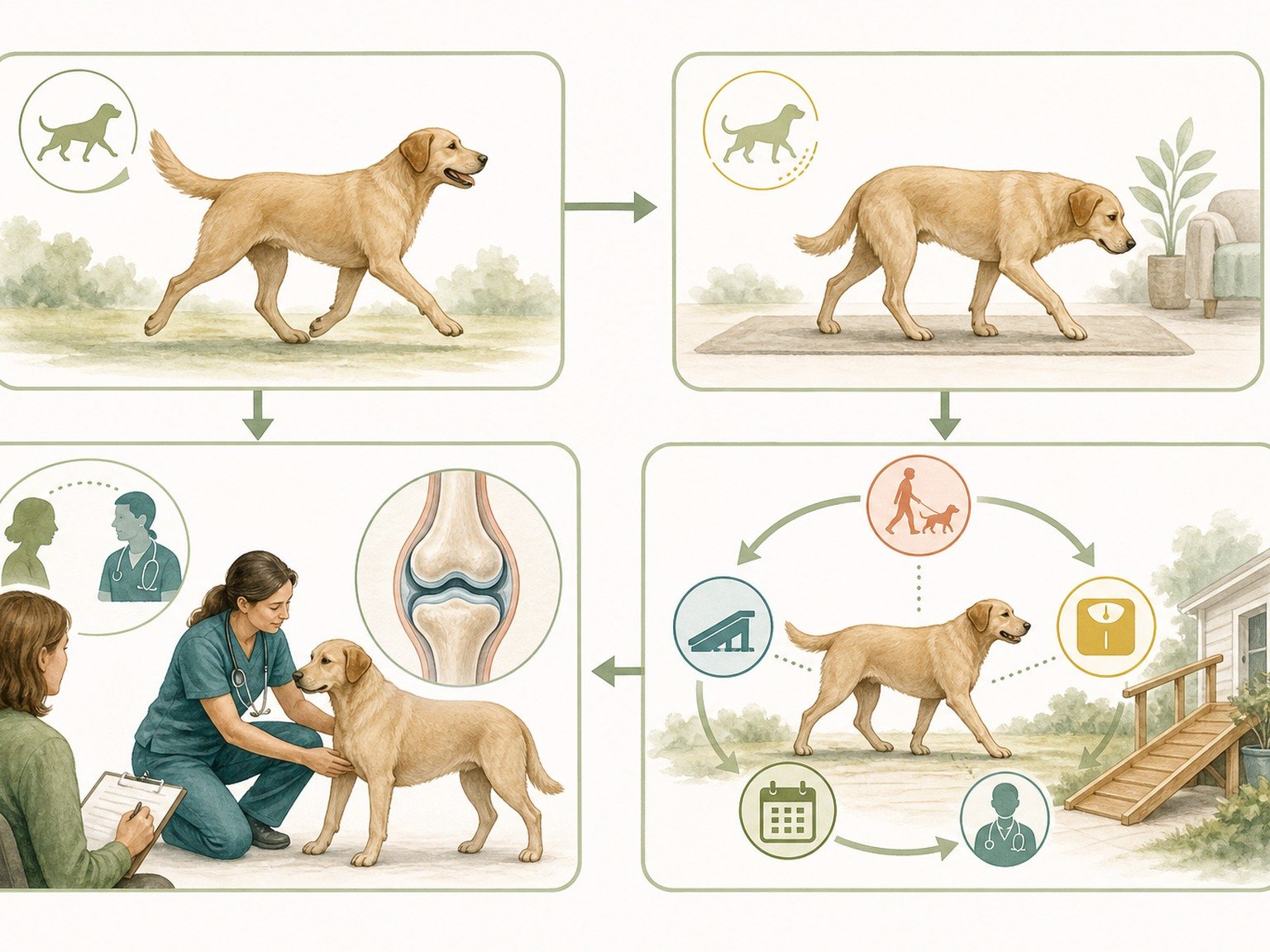
Recognize changes in pain and daily function
Look for slower rising, hesitation on stairs or into vehicles, shortened stride, shifting weight, toe scuffing, repeated slips, reduced jumping, lagging on walks, changed toileting posture, difficulty settling, nighttime restlessness, or less social interaction. [1]
Chronic pain may appear as irritability, withdrawal, altered attention, guarding, panting at rest, licking, reduced grooming tolerance, or reluctance to be touched. These signs are nonspecific; dental, neurologic, abdominal, skin, and other problems can create similar behavior.
Record onset, frequency, surface, weather only as an observation, activity before signs, duration, and recovery. Short natural-movement videos and a repeatable function score can reveal trends while avoiding forced tests that may hurt the dog.
How veterinarians diagnose and stage the problem
The veterinarian combines history with observation, palpation, joint range of motion, muscle condition, neurologic screening, gait evaluation, and examination of paws and nails. The goal is to localize the problem and identify diseases that resemble or accompany osteoarthritis.
Radiographs are commonly used to evaluate bone and joint changes and underlying conditions. Other imaging, joint sampling, or referral may be considered when findings, severity, or treatment decisions require more information. Imaging confirms anatomy but does not independently quantify pain. [4]
Structured staging frameworks can organize risk factors, clinical signs, examination, imaging, and function. A stage is not a home score or treatment recipe; it helps the veterinary team communicate and revisit the plan as the dog changes. [5]
What multimodal management and reassessment mean
Management may address body condition, controlled activity, rehabilitation, environmental modification, medication, nutrition, and treatment of an underlying mechanical cause. Surgery can be appropriate for selected primary problems or advanced joints. The combination depends on diagnosis, health, goals, resources, and response. [3]
Every option needs a defined benefit, risk, and monitoring plan. Medication decisions can require baseline or follow-up testing and interaction review. Exercise must be specific to the dog, and inappropriate intensity or technique can worsen signs. Supplements and devices also require exact-product, evidence, quality, and fit questions.
Track meaningful activities, pain-related behavior, body and muscle condition, sleep, adverse effects, and quality of life. Reassess on schedule and after important changes. A plan that once worked may need revision as disease, another illness, household circumstances, or the dog's goals change.
Prepare for a focused veterinary conversation
Bring a concise timeline, short natural-movement or symptom videos when safe, the exact names and photographs of every food, treat, medication, and supplement label, and notes about appetite, water intake, stool, sleep, activity, comfort, and behavior. Include recent injuries, travel, boarding, diet changes, missed medication, and previous test results. A complete record helps the veterinary team separate a repeatable pattern from a single impression.
Decide in advance what you need from the visit: an urgency decision, a diagnosis plan, a nutrition review, a pain or mobility assessment, or a monitored trial. Ask what result would change the plan and what finding would rule an option out. This keeps research and product information in the right role. Evidence can shape questions and expectations, but it cannot determine what is safe for an individual dog without the history and examination.
Owner tool
Track osteoarthritis function over time
On a phone, swipe across the table to see every column.
| Checkpoint | Record | Why it helps |
|---|---|---|
| Movement | Rise, stairs, stride, slips | Shows mobility |
| Comfort | Sleep, posture, touch, behavior | Shows pain impact |
| Context | Surface, activity, recovery, products | Supports interpretation |
| Review | Score, adverse effects, recheck | Guides revision |
Better questions, calmer next steps
Questions to ask your veterinarian
- What supports osteoarthritis and what else is possible?
- What would imaging or referral change?
- Which daily functions should we measure?
- What risks and monitoring apply to this plan?
- What sign needs urgent reassessment?
FAQ
Is osteoarthritis just old age?
No. Age and accumulated joint disease are different concepts.
Can an X-ray measure pain?
No. It must be integrated with function and examination.
Should a dog stop exercising?
Usually not by default; activity must be individualized.
Is management lifelong?
It commonly requires long-term monitoring and revision.
Can supplements replace veterinary treatment?
No. Their role, evidence, and safety must be assessed.
Sources
- Cornell University College of Veterinary Medicine: Osteoarthritis. Signs, diagnosis, treatment categories, and monitoring.
- American College of Veterinary Surgeons: Osteoarthritis in Dogs. Whole-joint disease, risk, multimodal care, and surgery.
- American Animal Hospital Association: Nonpharmacologic Modalities for Pain Management. Weight, movement, rehabilitation, environment, and evidence.
- American Animal Hospital Association: 2022 Pain Management Guidelines. Pain assessment, owner input, imaging, and reassessment.
- Frontiers in Veterinary Science: COAST Development and Validation Consensus. Canine osteoarthritis staging framework and limitations.
