

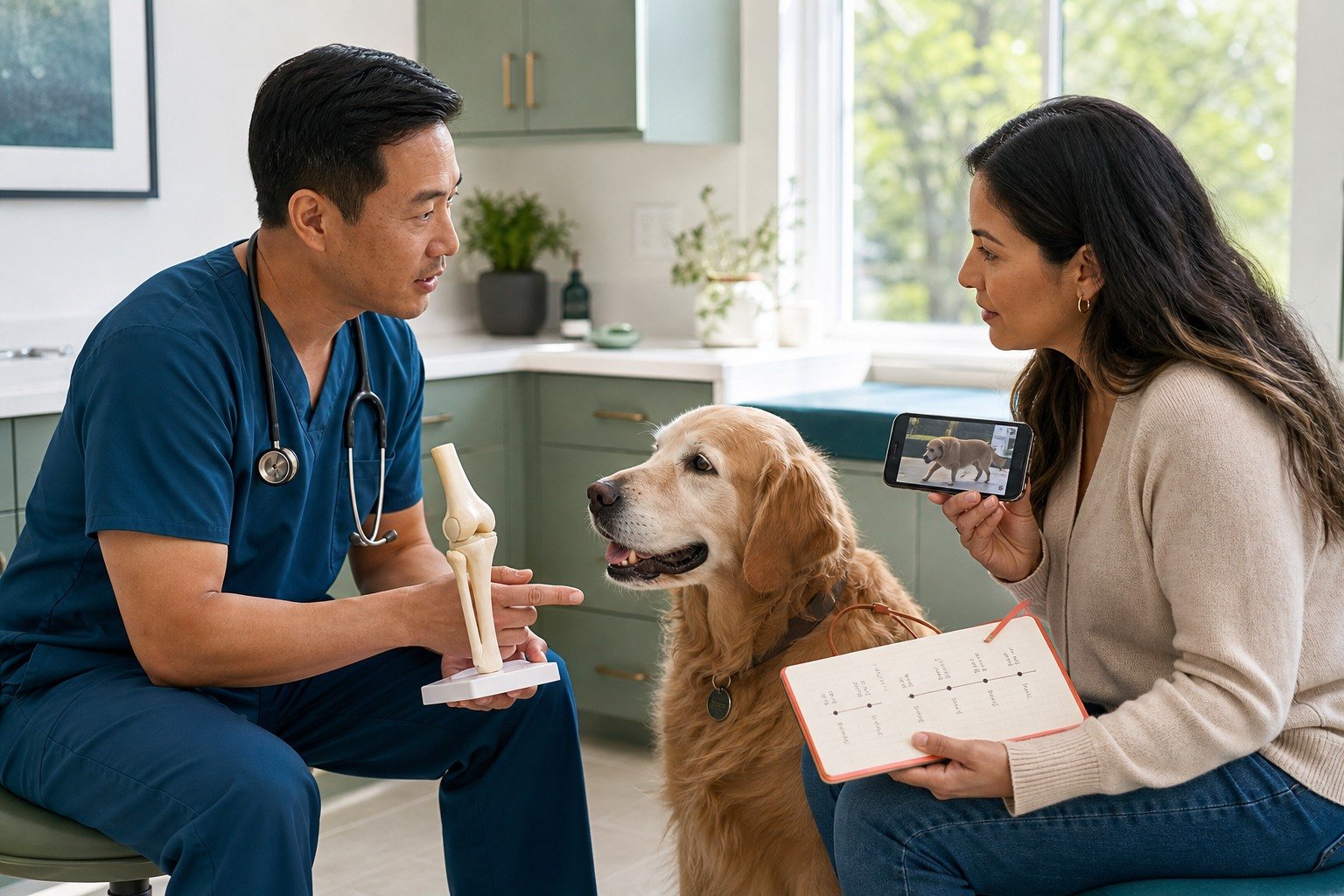
A productive joint-health appointment begins before the exam. Record what changed, when it happens, which activities are difficult, how long stiffness lasts, whether the dog slips or hesitates, and what recovery looks like after activity. Short videos of natural movement at home can capture function that stress or excitement may hide in the clinic. Bring medications, supplements, diets, prior imaging, injuries, and treatment response. Then ask what problems are being considered, how examination and imaging fit together, what each option is meant to achieve, and how progress will be measured. This guide helps owners organize a conversation; it does not diagnose osteoarthritis, identify a painful joint, select imaging, or recommend a drug, supplement, exercise, device, or dose.
Short answer
Ask questions that connect home function to a measurable plan
AAHA pain guidance treats assessment, treatment, reassessment, and plan revision as a continuum. Owner observation is central to chronic-pain evaluation, while imaging can confirm structural findings without perfectly matching pain or function. Bring a pattern and ask what would change the plan. [1] [2]
- Record changes in movement, appetite, stool, sleep, behavior, and daily function with dates.
- Use research to prepare questions, not to diagnose a dog or select treatment at home.
- Bring current diets, medications, supplements, prior records, and short natural-movement videos when useful.
- Agree on what to monitor, when to reassess, and which change requires urgent care.
Safety first
Sudden inability to bear weight or severe pain needs prompt assessment
Contact a veterinarian promptly for new or worsening lameness, stiffness, reluctance to rise, repeated slipping, reduced function, swelling, vocalization, appetite loss, or behavior change. Seek urgent care after major trauma, for an obvious deformity, uncontrolled pain, collapse, dragging limbs, inability to stand, or rapid neurologic decline.
- Do not delay care for sudden, severe, escalating, or function-limiting signs.
- Do not start, stop, combine, or calculate treatment from this article.
- Keep an exact timeline and product or exposure record available for the veterinary team.
Veterinary note
This article is educational and does not diagnose, treat, prescribe, or replace care from a licensed veterinarian. Your dog’s history, examination, diet, medications, and current signs determine what is appropriate.
Before the appointment: observe natural movement
Record rising, lying down, stairs, jumping, turning, toileting posture, play, leash walking, sleep, and willingness to interact. Note surface, time of day, activity before the sign, duration, affected limb if clear, and recovery. Avoid provoking pain to produce a video.
Use the same short route or daily task for comparison when it is safe. A video from the side and from behind can help the team see stride and symmetry, but it does not replace palpation, neurologic and orthopedic examination, or diagnostic testing. [2]
Bring a complete list of prescriptions, over-the-counter products, supplements, and diet. Include prior injuries, surgery, growth history, weight change, and responses or adverse effects from earlier plans. Do not stop prescribed care simply to create an untreated baseline.
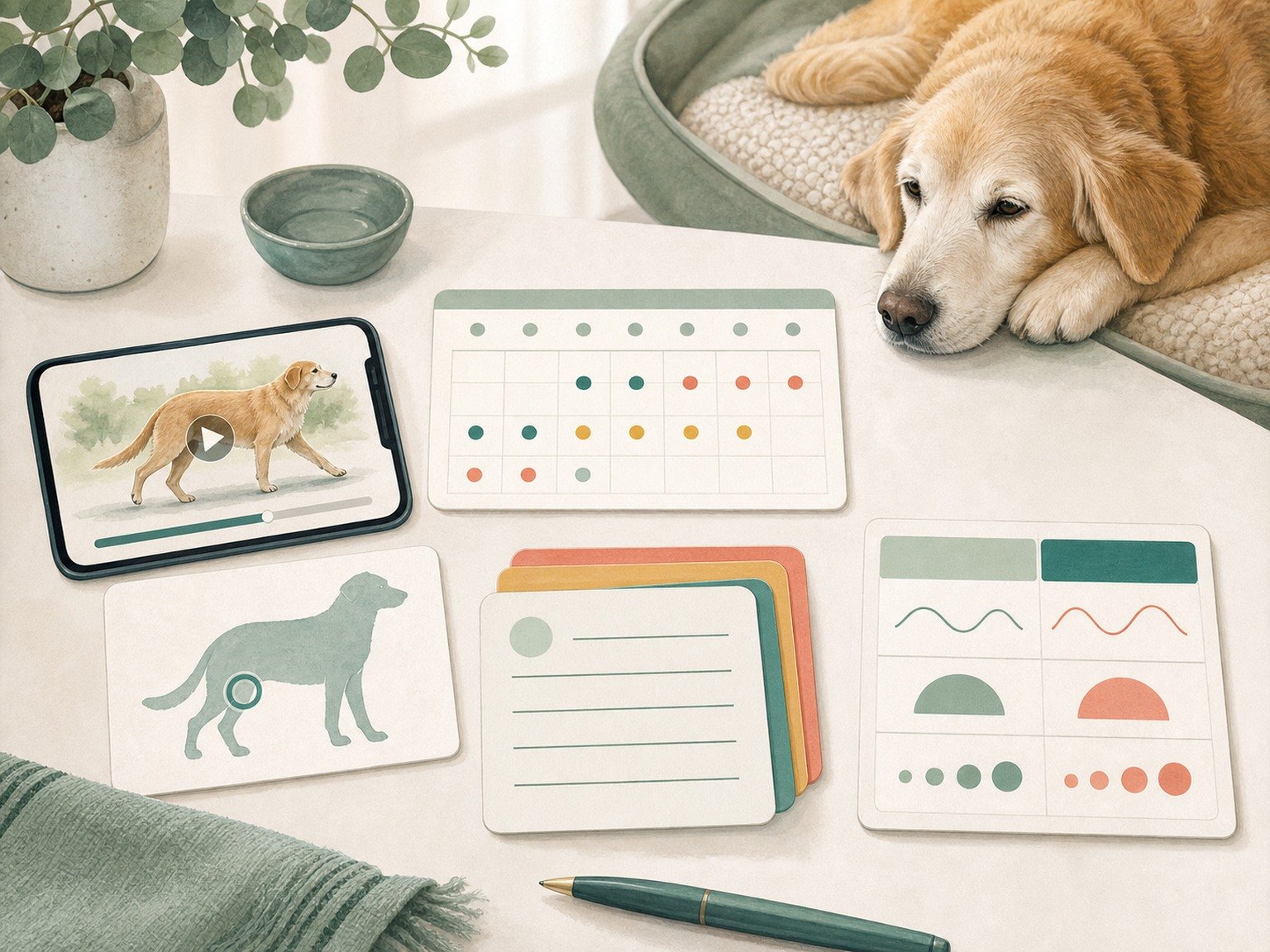
Questions about diagnosis, pain, and imaging
Ask which body systems and joints are being evaluated and which alternatives could mimic the pattern. Orthopedic, neurologic, muscular, foot, nail, and systemic problems can overlap. Request plain language for what the examination supports and what remains uncertain.
Ask what imaging could answer now and whether sedation, positioning, comparison views, or referral is relevant. Radiographic osteoarthritis and experienced pain do not always correlate closely, so the plan should integrate function, examination, and imaging rather than treat one picture in isolation. [2]
Ask whether a structured owner questionnaire or clinical metrology instrument would improve tracking. AAHA describes tools such as the Canine Brief Pain Inventory and Liverpool Osteoarthritis in Dogs instrument as ways to follow chronic pain and function over time. [1]
Questions about management options and tradeoffs
Ask for the goal of each option: pain reduction, improved function, protection of a repaired structure, weight optimization, strength, safer daily activity, or another outcome. A multimodal plan can combine approaches, but more components are not automatically better. [3]
For any medication, ask about expected benefit, common and serious adverse effects, interactions, baseline testing, monitoring, administration, missed doses, and what not to combine. For rehabilitation or exercise, ask what movement is permitted, what technique and progression are appropriate, and what sign means stop and call.
For supplements, diets, braces, harnesses, ramps, or other devices, ask what evidence applies to the exact patient and objective, how fit or quality will be assessed, and how response will be distinguished from normal variation. Do not substitute an online product for a diagnostic or treatment plan.
Questions about monitoring and follow-up
Agree on two or three meaningful outcomes such as rising, a defined walk, stairs, sleep, play, or a validated score. Record baseline before judging change, and note adverse effects and other health changes alongside mobility. [1]
Ask when reassessment should occur and what would trigger earlier contact, repeat testing, imaging, referral, or plan revision. Osteoarthritis management is commonly long term and individualized; stable monitoring matters even when the dog has a good week. [4]
Before leaving, repeat the instructions in your own words and confirm after-hours guidance. Ask who coordinates care if a surgeon, rehabilitation veterinarian, nutrition professional, or other specialist becomes involved. Keep one current plan so different caregivers do not give conflicting activity or product instructions.
Prepare for a focused veterinary conversation
Bring a concise timeline, short natural-movement or symptom videos when safe, the exact names and photographs of every food, treat, medication, and supplement label, and notes about appetite, water intake, stool, sleep, activity, comfort, and behavior. Include recent injuries, travel, boarding, diet changes, missed medication, and previous test results. A complete record helps the veterinary team separate a repeatable pattern from a single impression.
Decide in advance what you need from the visit: an urgency decision, a diagnosis plan, a nutrition review, a pain or mobility assessment, or a monitored trial. Ask what result would change the plan and what finding would rule an option out. This keeps research and product information in the right role. Evidence can shape questions and expectations, but it cannot determine what is safe for an individual dog without the history and examination.
Owner tool
Prepare a joint-health appointment brief
On a phone, swipe across the table to see every column.
| Checkpoint | Record | Why it helps |
|---|---|---|
| Function | Rising, stairs, walk, play, sleep | Shows daily impact |
| Pattern | Onset, surface, activity, recovery | Adds context |
| History | Injuries, drugs, products, imaging | Finds constraints |
| Plan | Goals, risks, measure, recheck | Supports follow-up |
Better questions, calmer next steps
Questions to ask your veterinarian
- Which diagnoses and body systems are being considered?
- What would imaging change?
- How will pain and function be measured?
- What are the risks and monitoring needs of each option?
- What change requires urgent care?
FAQ
Should I bring a video?
Yes, if it shows natural movement without provoking pain.
Does an X-ray show how much pain my dog has?
Not reliably by itself.
Should I ask about supplements?
Yes, with exact products and the full medication list.
What should I track?
Choose repeatable daily functions and adverse effects.
When should the plan be reviewed?
Set a date and earlier-contact triggers with the veterinarian.
Sources
- American Animal Hospital Association: 2022 Pain Management Guidelines. Assessment, owner input, multimodal care, and reassessment.
- American Animal Hospital Association: 2022 Pain Guidelines Overview. Owner observations, examination, imaging limits, and measurement.
- American Animal Hospital Association: Nonpharmacologic Modalities for Pain Management. Weight, movement, environment, and evidence context.
- Cornell University College of Veterinary Medicine: Osteoarthritis. Signs, diagnosis, individualized management, and monitoring.
- American College of Veterinary Surgeons: Osteoarthritis in Dogs. Multimodal management, activity, rehabilitation, and surgery context.
