


Synthetic canine appeasing pheromone products have been studied as collars, diffusers, sprays, gels, and related formulations in adoption, noise, shelter, hospitalization, and veterinary-visit settings. A systematic review found insufficient evidence for most evaluated uses and important study-quality limitations. Later controlled studies have reported selected differences in defined populations, while other outcomes showed no significant difference. Formulation, exposure context, concurrent care, outcome, and study design limit transfer. This article names no brand, ranking, price, application protocol, or stand-alone treatment claim. When reading a result, separate statistical significance from practical importance and note which outcomes did not change. A waiting-room behavior, physiologic measure, hospitalization sign, and household fear response are not interchangeable. The full result is more informative than a single favorable endpoint. Record neutral or adverse responses as carefully as favorable ones, and avoid changing several parts of the behavior plan at once. Otherwise an apparent improvement cannot be attributed responsibly to the formulation.
Short answer
Evidence for one formulation does not validate the category
A collar study in laboratory beagles, a gel study during standardized visits, and a diffuser study in hospitalized dogs ask different questions. A statistically significant difference in one measured behavior does not prove broad relief or reliable benefit for every dog. The evidence is mixed, context-specific, and best interpreted as possible adjunct evidence within veterinarian-directed care. [1] [2] [3] [4]
- Record context, frequency, duration, recovery, function, and recent change.
- Treat the article as preparation for professional assessment, not a diagnostic test.
- Agree on monitoring, reassessment, and urgent-response instructions with the veterinary team.
- Bring calm-day and difficult-day observations to each follow-up.
Safety first
Pheromone products should not delay assessment of severe or escalating behavior
Contact a veterinarian for persistent panic, escape, self-injury, aggression, inability to rest or eat, sudden behavior change, or signs of pain. If people or animals are at immediate risk, use safe separation and seek urgent professional guidance. Do not rely on a diffuser, collar, spray, or gel as crisis management.
- Do not delay care for severe, persistent, escalating, or function-limiting signs.
- Do not start, stop, combine, or calculate treatment from this article.
- Preserve dated observations, safe videos, labels, prior records, and the dog's full health context.
Veterinary note
This article is educational and does not diagnose, treat, prescribe, or replace care from a licensed veterinarian. Your dog’s history, examination, diet, medications, and current signs determine what is appropriate.
Define the product category precisely
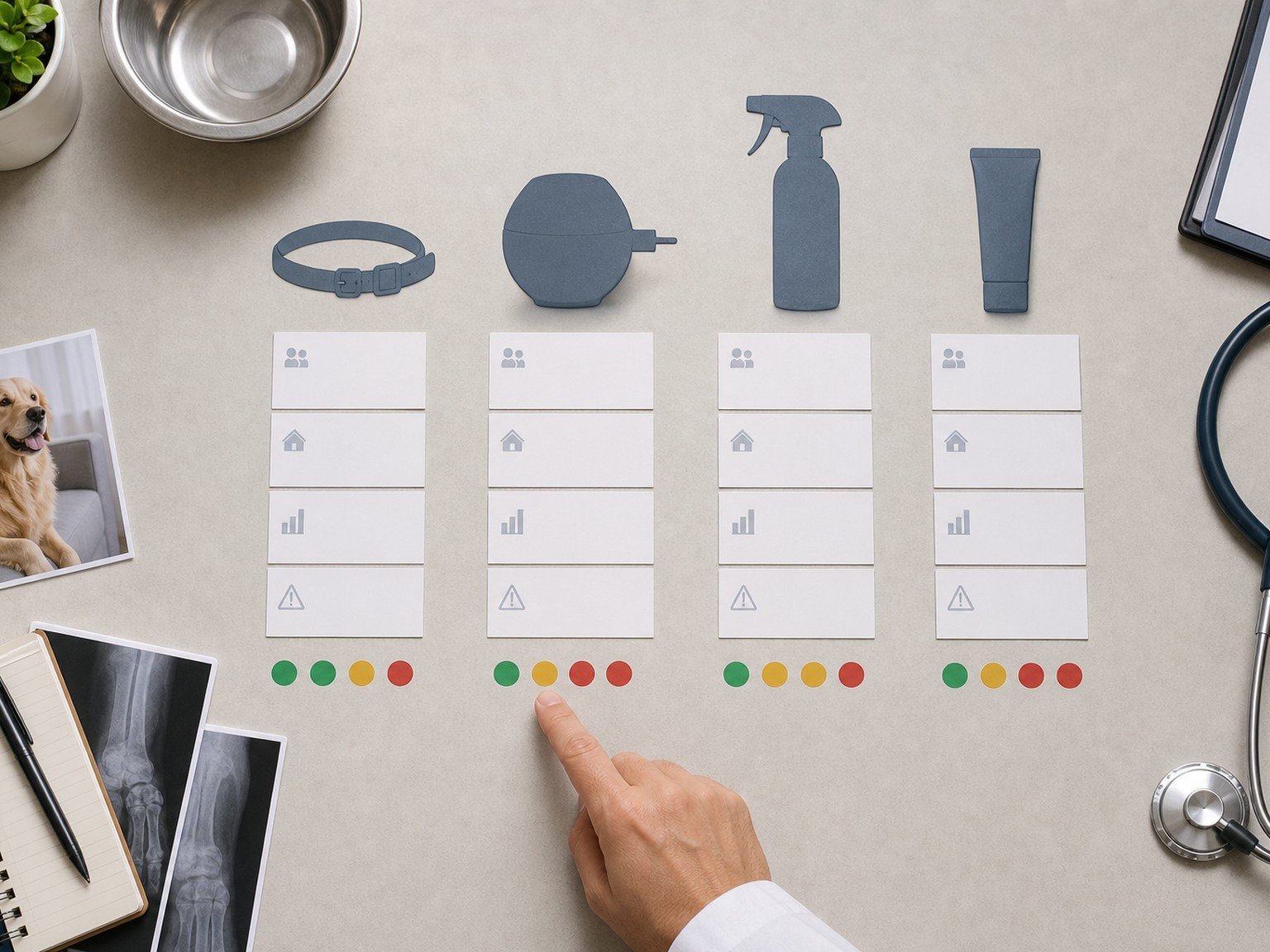
Synthetic dog-appeasing pheromone products are intended to mimic chemical signals and are sold in several delivery formats. A collar, diffuser, spray, and gel differ in formulation, exposure, setting, and study design. They should not be conflated with herbs, supplements, medications, essential oils, or behavior modification.
A product can be marketed for broad calming while evidence examines one setting and one outcome. Read the exact formulation, population, comparator, concurrent management, and endpoint before extending a claim.
Response to a product does not diagnose the underlying behavior problem. Improvement, no change, or worsening can coincide with other environmental, medical, learning, or caregiver variables.
Start with the systematic-review limit
A systematic review of pheromones for undesirable behavior in dogs and cats found insufficient evidence for most canine uses it evaluated and identified important quality limitations. The review included noise, travel, veterinary, shelter, and adoption contexts. [1]
Insufficient evidence is not proof that every product never affects any dog. It means confidence is too limited for broad effectiveness claims, universal recommendations, or guaranteed outcomes.
Older studies may use formulations or methods that differ from current products, while newer studies do not automatically erase design limitations. Evidence should be updated by question, not by advertising language.
Compare later studies without ranking products
A placebo-controlled study in a small defined beagle population reported selected changes during simulated thunder exposure. Laboratory population, model, formulation, and measured behaviors limit transfer to naturally occurring household fear. [2]
A study of a gel formulation in 28 dogs during standardized veterinary visits found selected waiting-room behavior differences, while physiological measures and examination-room outcomes did not differ significantly. Mixed outcomes matter. [3]
A hospitalized-dog study reported changes in selected separation-related signs, but medical condition, pain, confinement, staffing, and environment complicate interpretation. It does not establish a home separation-anxiety treatment. [4]
Discuss an adjunct without turning it into a protocol
Ask the veterinary team what diagnosis or concern is being addressed, what evidence applies to the exact formulation and setting, what concurrent care continues, and what observable outcome would justify reassessment.
This article provides no brand, dose, placement, application, replacement schedule, duration, or safety guarantee. Do not spray a dog, alter a device, combine products, or use near another species based on general content. Follow professional and verified label guidance for any actual product considered.
Keep the behavior plan primary. Management, low-stress handling, behavior modification, medication, medical care, or specialist support may be needed depending on the dog. A pheromone product cannot replace safety planning or professional assessment.
Prepare for a focused veterinary conversation
Bring a concise timeline, short natural-movement or symptom videos when safe, the exact names and photographs of every food, treat, medication, and supplement label, and notes about appetite, water intake, stool, sleep, activity, comfort, and behavior. Include recent injuries, travel, boarding, diet changes, missed medication, and previous test results. A complete record helps the veterinary team separate a repeatable pattern from a single impression.
Decide in advance what you need from the visit: an urgency decision, a diagnosis plan, a nutrition review, a pain or mobility assessment, or a monitored trial. Ask what result would change the plan and what finding would rule an option out. This keeps research and product information in the right role. Evidence can shape questions and expectations, but it cannot determine what is safe for an individual dog without the history and examination.
Owner tool
Appraise a pheromone study
On a phone, swipe across the table to see every column.
| Checkpoint | Record | Why it helps |
|---|---|---|
| Formulation | Collar, diffuser, spray, gel | Prevents category drift |
| Setting | Noise, visit, shelter, hospital | Limits transfer |
| Outcome | Specific behavior or physiology | Defines claim |
| Context | Population, concurrent care, design | Shows uncertainty |
Better questions, calmer next steps
Questions to ask your veterinarian
- What exact formulation and setting were studied?
- Which outcome would matter for this dog?
- What concurrent care remains necessary?
- What would count as no benefit or worsening?
- When should we reassess the diagnosis and plan?
FAQ
Are pheromone products proven for every anxious dog?
No. Evidence is mixed and context-specific.
Does one collar study validate diffusers?
No. Formulations and exposure differ.
Can response confirm anxiety?
No. Product response is not a diagnostic test.
Is there a universally safe protocol?
This source set supports no universal guarantee or application protocol.
Can pheromones replace behavior care?
No. They are only possible adjuncts.
Sources
- Journal of the American Veterinary Medical Association: Systematic Review of Pheromones. Insufficient evidence and study limits.
- Veterinary Record: Pheromone Collars and Sound-Induced Fear. Defined beagle study and transfer limits.
- Animals: Pheromone Gel During Clinical Examination. Mixed behavioral and physiologic outcomes.
- Canadian Veterinary Journal: Pheromone for Hospitalized Dogs. Selected signs and hospital confounders.
