

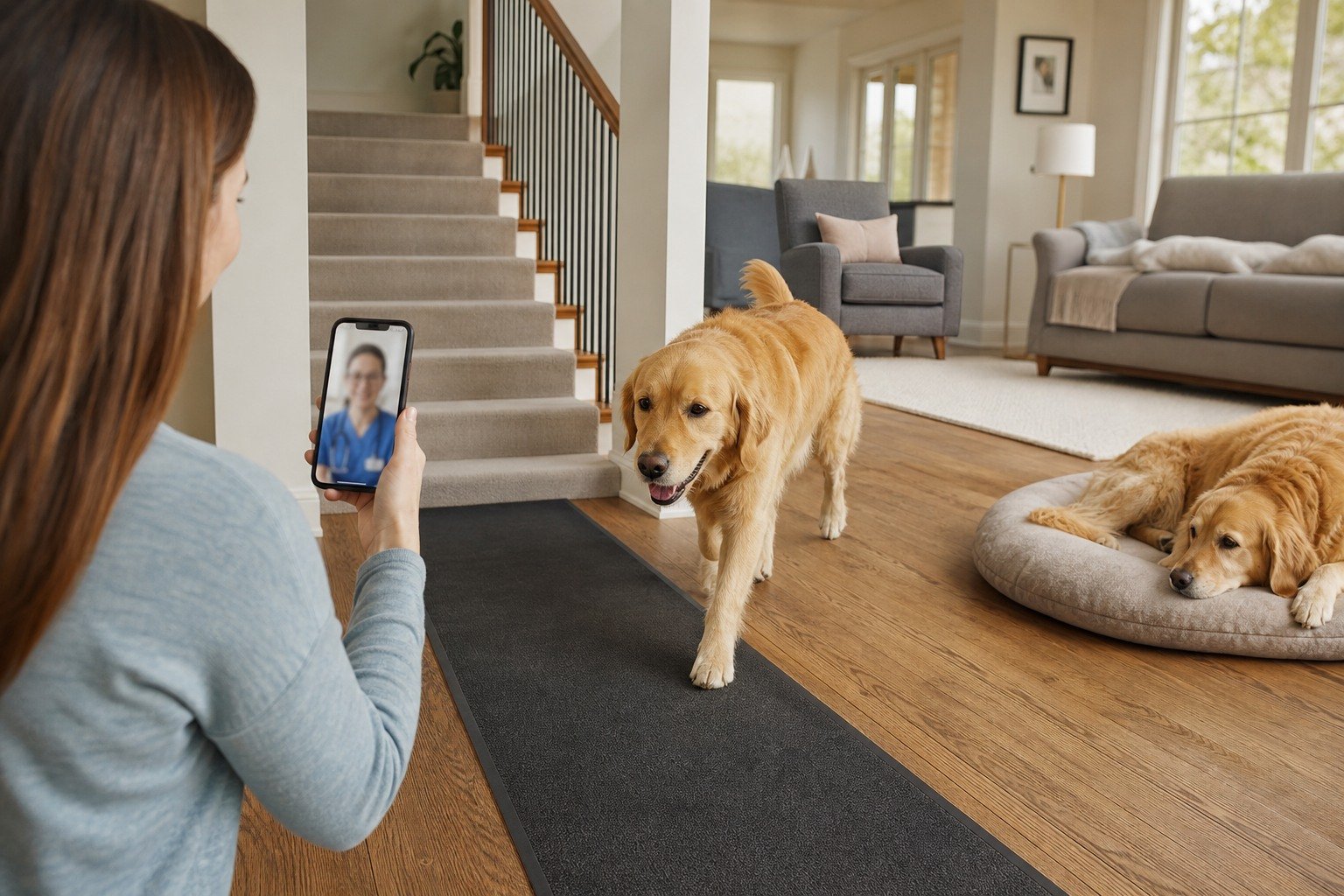
A home mobility log is most useful when it follows the same ordinary functions over time. It can show that a dog takes longer to rise, shortens a step after activity, pauses before stairs, changes sleeping position, or stops joining a routine walk. Those observations matter, but they do not identify arthritis, a painful joint, an injury, neurologic disease, or a treatment. Gait and behavior can change for many orthopedic, neurologic, systemic, environmental, and emotional reasons. The goal is longitudinal communication: establish an individual baseline, capture comparable observations without provoking pain, and bring meaningful change to the veterinary team.
Short answer
Track change from baseline, not a home diagnosis
AAHA supports repeated owner observations, comparison with baseline, validated questionnaires, and activity-specific videos. Evidence reviews show that selected owner-reported tools can measure defined aspects of canine osteoarthritis while retaining interpretation limits. Lameness still requires veterinary history, observation, examination, and selected testing to identify cause. [1] [2] [3]
- Start with the individual dog's baseline, complete history, and current veterinary plan.
- Use repeated observations to improve a veterinary discussion, not to diagnose or treat at home.
- Keep associations, population findings, and research endpoints within their actual limits.
- Escalate sudden, severe, persistent, progressive, or function-limiting signs promptly.
Safety first
A log never creates a safe waiting period
Seek prompt care for inability to bear weight, severe or escalating pain, trauma, swelling, collapse, dragging or knuckling a limb, inability to rise, loss of bladder or bowel control, fever, or rapid decline. Contact the veterinary team for sudden, persistent, progressive, recurring, or function-limiting changes rather than waiting for more entries.
- Do not delay urgent care while completing a log, testing a theory, or looking for a lower-cost option.
- Do not start, stop, combine, divide, or calculate medication or supplements from this article.
- After a possible toxin, foreign object, overdose, or hazardous ingestion, contact veterinary or poison help promptly.
Veterinary note
This article is educational and does not diagnose, treat, prescribe, or replace care from a licensed veterinarian. Your dog’s history, examination, diet, medications, and current signs determine what is appropriate.
Choose ordinary functions that matter to this dog
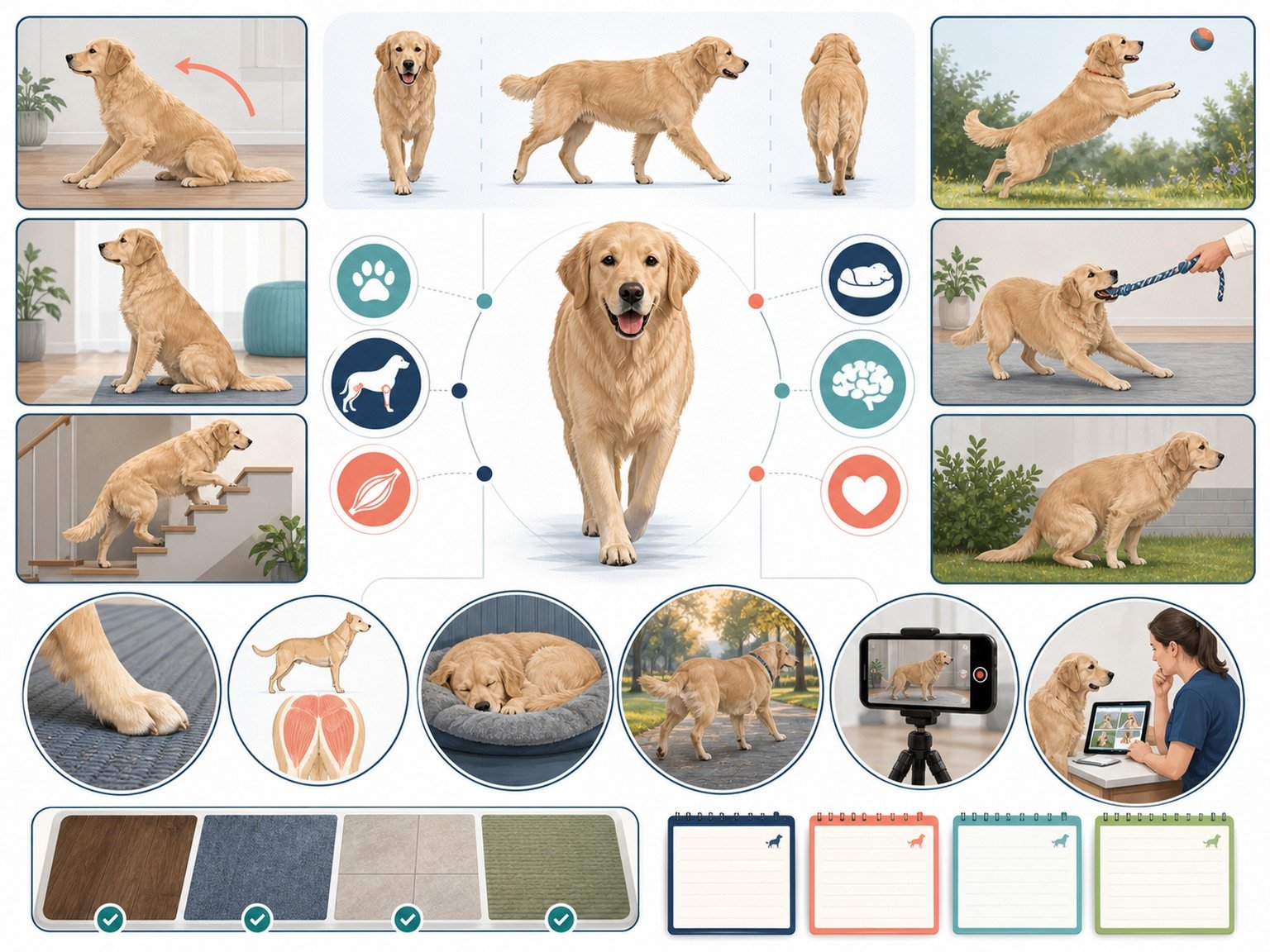
Start with five to eight repeatable activities: rising after rest, walking on a familiar surface, turning, toileting, getting to food and water, using necessary steps, joining a short walk, settling to sleep, or entering a vehicle when already routine. Do not add a challenging task solely for testing.
Describe the baseline before describing the problem. Include usual pace, stride, posture, willingness, assistance, duration, recovery, and normal variation after activity or rest. A dog's age, body shape, diagnosis, home, and learned habits affect appearance, so comparison with another dog is less useful than comparison with itself.
AAHA chronic-pain guidance supports normal-versus-abnormal comparison and repeated observations. [1] Use neutral language: three attempts to rise, paused before the first step, or shortened left hind stride. Avoid diagnostic labels such as arthritis flare, hip pain, or bad knee unless the veterinarian has established them.
Capture comparable notes and videos
Use the same surface, approximate camera position, activity, and time context when practical. Record date, duration, recent activity, medication timing, slips, sleep, appetite, and unusual events. Consistency helps interpretation, but home conditions do not need to become a laboratory protocol.
Short videos can show intermittent or task-specific change that is absent in the clinic. Capture natural movement only. Do not repeatedly call, chase, leash-pull, force stairs, make the dog jump, manipulate limbs, or continue after reluctance or distress.
Owner-reported outcome measures can add structure for defined populations and uses, but systematic evaluation identifies limits in interpretability and transfer. [2] A score is not a diagnosis, pain dose calculator, universal emergency threshold, or proof that treatment worked.
Look for trends across the whole dog
Track gait, posture, rising, stairs, play, rest, sleep, licking, social participation, appetite, toileting, endurance, and recovery. A change in one domain can be more meaningful when it occurs with several others, but the pattern remains nonspecific.
MSD describes lameness as a clinical sign with many possible causes and explains that veterinary evaluation uses history, observation, examination, and selected testing. [3] Cornell similarly presents osteoarthritis as a veterinary diagnosis based on history, examination, and imaging or other evaluation when indicated. [4]
Include medication and supplement changes, illness, travel, surfaces, weather, activity, and body-weight trend. These details can explain variation or expose a new question. Do not alter treatment to make the graph improve; report the trend and ask what it means.
Share a concise record and agree on follow-up
Summarize the most important change in one sentence, then provide representative dates and clips rather than an unfiltered archive. State which daily function is affected, whether the pattern is progressing, and what has or has not changed in the current plan.
Ask whether the pattern suggests an examination, diagnostics, medication review, rehabilitation assessment, weight or activity discussion, or another step. The veterinarian may interpret the same movement differently after hands-on and neurologic assessment.
Continue monitoring only within an agreed plan. Know which change triggers earlier contact, what outcome is being followed, and when routine reassessment is due. The log succeeds when it improves communication and decisions, not when it produces a self-diagnosis.
Prepare for a focused veterinary conversation
Bring a concise timeline, short natural-movement or symptom videos when safe, the exact names and photographs of every food, treat, medication, and supplement label, and notes about appetite, water intake, stool, sleep, activity, comfort, and behavior. Include recent injuries, travel, boarding, diet changes, missed medication, and previous test results. A complete record helps the veterinary team separate a repeatable pattern from a single impression.
Decide in advance what you need from the visit: an urgency decision, a diagnosis plan, a nutrition review, a pain or mobility assessment, or a monitored trial. Ask what result would change the plan and what finding would rule an option out. This keeps research and product information in the right role. Evidence can shape questions and expectations, but it cannot determine what is safe for an individual dog without the history and examination.
Owner tool
Create a longitudinal mobility log
On a phone, swipe across the table to see every column.
| Checkpoint | What to record | Why it helps |
|---|---|---|
| Baseline | Usual gait, rising, rest, tasks, variation | Defines normal |
| Observation | Date, task, surface, context, video | Shows change |
| Whole dog | Sleep, appetite, toileting, behavior, recovery | Adds context |
| Follow-up | Function, trend, questions, contact trigger | Guides review |
Better questions, calmer next steps
Questions to ask your veterinarian
- Which functions should I track for this dog?
- Are these videos representative and safe?
- Could neurologic or systemic disease resemble this pattern?
- What outcome should define response?
- Which change requires earlier contact?
FAQ
Can a checklist diagnose arthritis?
No.
Can it identify the painful joint?
No.
How long should videos be?
Short enough to show ordinary representative movement.
Should I test range of motion?
No; do not manipulate joints at home.
When should tracking stop and care begin?
Promptly for sudden, severe, persistent, progressive, or concerning change.
Sources
- American Animal Hospital Association: Chronic Pain Assessment in Dogs. Baseline, repeated observations, questionnaires, and videos.
- Veterinary Surgery: Evidence-Based Evaluation of Owner-Reported Outcome Measures. Validated measures and interpretation limits.
- MSD Veterinary Manual: Lameness in Dogs. Multiple causes and veterinary evaluation.
- Cornell University College of Veterinary Medicine: Osteoarthritis. Clinical signs, diagnosis, and individualized care.
