


Desensitization and counter-conditioning are related but distinct behavior-change processes. Desensitization presents a trigger at a low enough intensity that the dog can remain safe and able to learn, then changes one dimension gradually. Counter-conditioning repeatedly pairs that manageable trigger with something the dog values to build a different emotional association. Neither means distracting a panicked dog, flooding the dog until it stops reacting, forcing proximity, or punishing warning signals. A correct plan identifies the exact trigger dimensions, earliest body language, working distance or intensity, reinforcer, session length, stop signs, recovery, and progression rule. Medical issues, aggression risk, and severe anxiety can change what is safe and may require a veterinarian or board-certified veterinary behaviorist. This guide explains principles, not a trigger-specific protocol.
Short answer
Low intensity and emotional safety are the foundation
Merck describes desensitization as carefully graded exposure below the fear response and counter-conditioning as pairing that reduced trigger with a positive outcome. Moving too quickly provokes anxiety and sabotages learning; flooding can worsen fear and creates welfare risk. [1] [2]
- Record the trigger, distance or intensity, body language, recovery, and whole-dog function with dates.
- Use research to prepare a veterinary conversation, not to diagnose or run a treatment protocol alone.
- Bring every medication, supplement, diet, prior plan, and safe home video to the appointment.
- Agree on safety rules, measurable outcomes, reassessment timing, and urgent-contact signs.
Safety first
Do not practice around bite, escape, or self-injury risk without qualified help
Stop and seek professional guidance when a dog cannot eat or recover, freezes, flees, lunges, snaps, redirects, injures itself, destroys barriers, or becomes more sensitive across sessions. Use distance and secure barriers. Seek urgent veterinary care for sudden behavior change with pain, collapse, seizure, breathing difficulty, toxin exposure, or rapid neurologic decline.
- Do not force exposure, punish fear, or prevent escape to make a dog appear calm.
- Do not start, stop, combine, or calculate medication or treatment from this article.
- Protect people and animals with distance, barriers, supervision, and qualified help.
Veterinary note
This article is educational and does not diagnose, treat, prescribe, or replace care from a licensed veterinarian. Your dog’s history, examination, diet, medications, and current signs determine what is appropriate.
Separate the two learning processes
Desensitization changes the intensity of the trigger: distance, volume, duration, movement, size, number, or context. The starting point must be easy enough that the dog notices without escalating into fear.
Counter-conditioning changes the predicted meaning of the trigger by pairing it with a valued outcome. The trigger should predict the good thing, and the dog must remain able and willing to take it; food refusal can be a useful stress signal.
The techniques are often combined, but a dog performing a trained behavior is not proof of emotional change. Watch the whole body and recovery rather than judging success only by silence or compliance. [1]
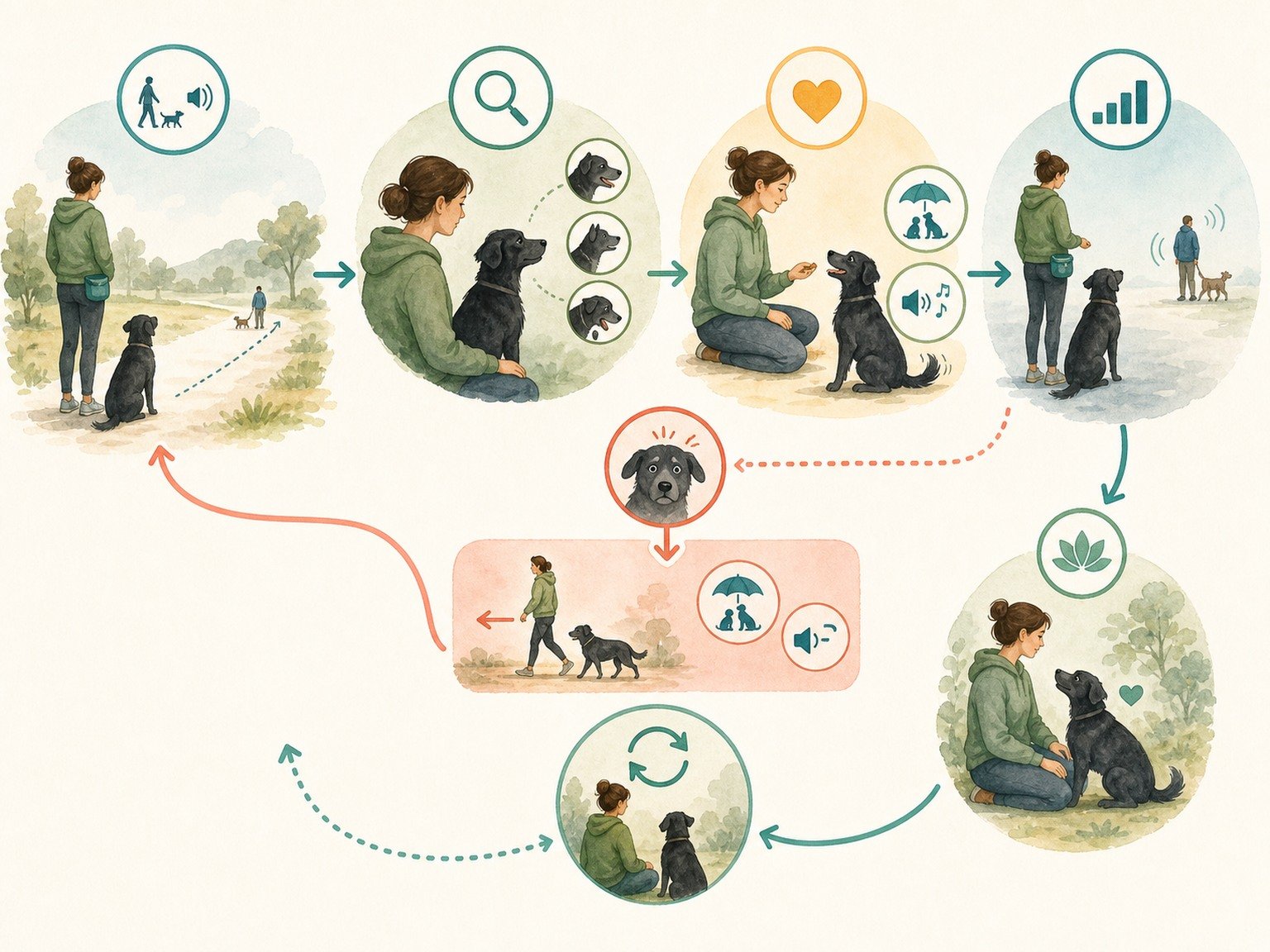
Define threshold and control one variable
Threshold is not a fixed line. Sleep, pain, prior exposures, environment, hunger, medication, and stacked stressors can change what a dog can handle on a given day.
Adjust one trigger dimension at a time when possible. Increasing distance and duration together makes it hard to know what caused a response. Sessions should be brief enough to preserve success and recovery.
If stress increases, reduce intensity, add distance, use a barrier, or end the session. Repeated high-intensity exposure can sensitize rather than desensitize the dog. [2]
Avoid flooding, punishment, and forced restraint
Flooding maintains exposure at a fear-provoking level and can increase fear or produce shutdown that is mistaken for calm. Merck describes it as seldom effective and potentially inhumane when used incorrectly. [2]
Punishment can suppress signals without changing fear, increase negative association with the trigger, and raise aggression risk. Dominance-based confrontation and leash corrections are not substitutes for treatment.
Management is not failure. Preventing uncontrolled rehearsals through distance, barriers, scheduling, sound reduction, or alternate routes protects welfare and makes planned learning possible. [3]
Build a specialist-guided progression
Start with a veterinary evaluation when behavior is new, severe, or changing. A qualified professional can identify trigger components, safety requirements, learning history, reinforcers, and whether medication could improve welfare and trainability.
Track starting intensity, body language, food acceptance, recovery time, repetitions, context, and the next planned step. Do not advance simply because a calendar interval passed.
Progress is often uneven and context-specific. Generalization to a new person, location, sound, or movement may require easier steps again. AAHA recommends low-stress, positive methods and appropriate referral for concerning behavior. [4] [5]
Keep the care and training record consistent
Practice should improve the dog's ability to recover as well as tolerate the planned trigger. Preserve easy sessions and rest days in the record, and note unplanned exposures that may change the next starting point. When several caregivers participate, use the same trigger definition, body-language stop signs, reinforcer, and progression rule so inconsistency does not increase uncertainty or fear.
Prepare for a focused veterinary conversation
Bring a concise timeline, short natural-movement or symptom videos when safe, the exact names and photographs of every food, treat, medication, and supplement label, and notes about appetite, water intake, stool, sleep, activity, comfort, and behavior. Include recent injuries, travel, boarding, diet changes, missed medication, and previous test results. A complete record helps the veterinary team separate a repeatable pattern from a single impression.
Decide in advance what you need from the visit: an urgency decision, a diagnosis plan, a nutrition review, a pain or mobility assessment, or a monitored trial. Ask what result would change the plan and what finding would rule an option out. This keeps research and product information in the right role. Evidence can shape questions and expectations, but it cannot determine what is safe for an individual dog without the history and examination.
Owner tool
Plan one low-intensity learning session
On a phone, swipe across the table to see every column.
| Checkpoint | Record | Why it helps |
|---|---|---|
| Trigger | Dimension and starting level | Controls exposure |
| Body | Ear, eye, posture, appetite | Shows threshold |
| Pairing | Reward and timing | Builds association |
| Review | Recovery and next step | Prevents rushing |
Better questions, calmer next steps
Questions to ask your veterinarian
- What exact trigger dimensions matter?
- What is this dog's earliest stress signal?
- How low should the starting intensity be?
- What sign means increase distance or stop?
- Do medical care, medication, or referral need to precede practice?
FAQ
Are the two terms identical?
No. One grades exposure; the other changes association.
What if my dog will not eat?
Reduce intensity and reassess stress.
Should I wait until the dog stops reacting?
No. That can become flooding.
Can punishment speed progress?
No. It can worsen fear and risk.
How fast should we advance?
Only as the dog's body language and recovery support.
Sources
- Merck Veterinary Manual: Behavior Modification in Dogs. Definitions, progression, flooding, and punishment risks.
- Merck Veterinary Manual: Treatment of Behavior Problems in Animals. Threshold, emotional change, management, and medication integration.
- American Animal Hospital Association: Behavior Management Guidelines PDF. Humane behavior assessment and treatment.
- American Animal Hospital Association: Canine Life Stage Behavior Guidance. Sensitization, veterinary role, and low-stress methods.
- American College of Veterinary Behaviorists: Resources for Animal Owners. Specialist resources for complex cases.
