

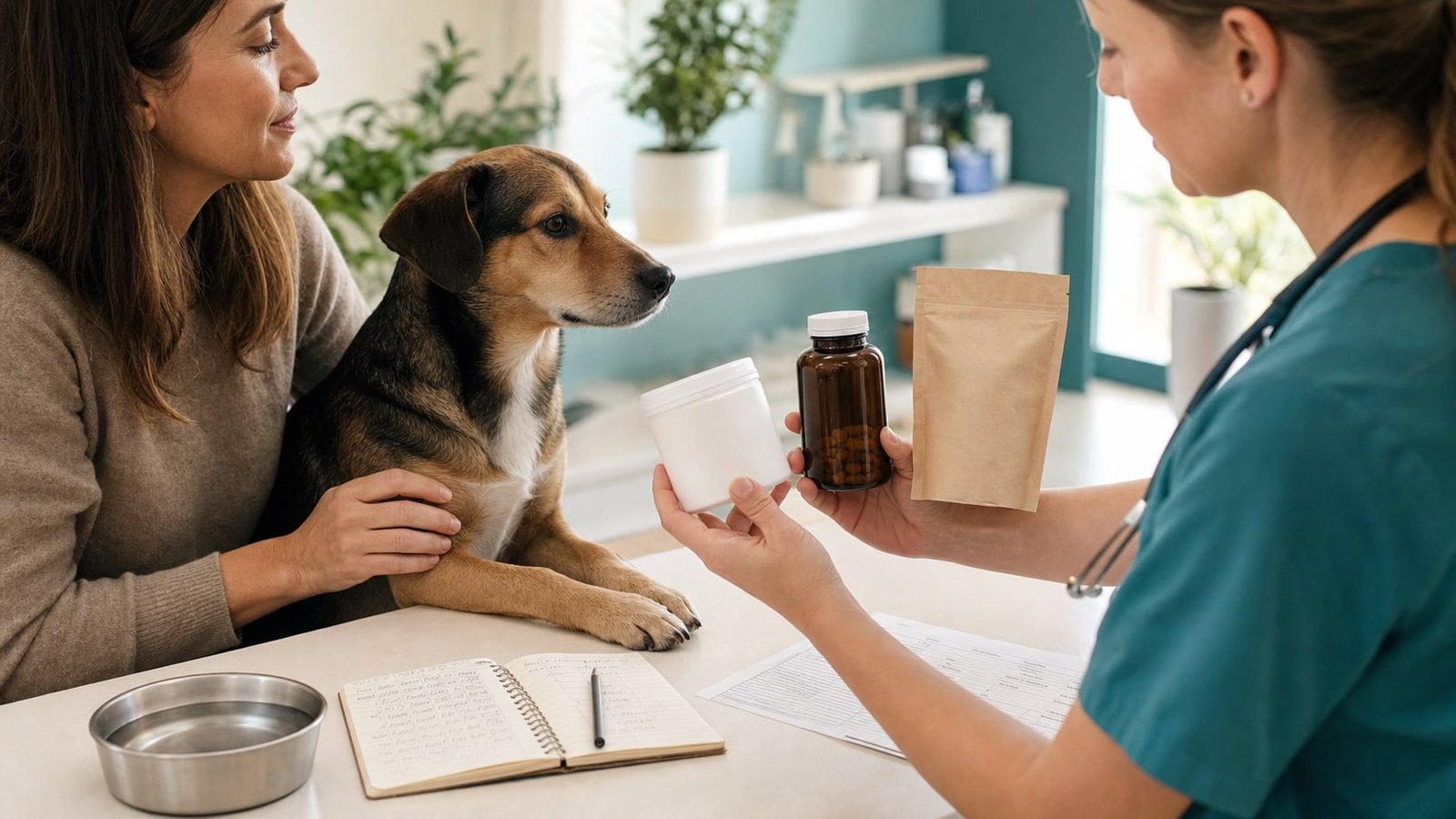
The best dog probiotic is not the package with the loudest claim or the largest number on the front. It is a product whose identified strains, viable count, storage requirements, directions, safety information, and evidence fit the reason your dog may need support. For ongoing or serious digestive signs, the first decision is veterinary assessment, not a supplement.
Short answer
Choose for the dog and the clinical question
There is no single probiotic that is best for every dog. Canine studies use different strains, combinations, doses, populations, and outcomes, so a positive result for one formulation cannot be transferred automatically to every product labeled probiotic. [1] [2]
- Look for named microorganisms at strain level, not only a broad species or a proprietary blend.
- Confirm whether the viable count is guaranteed through expiration and how the product must be stored.
- Check directions for your dog’s life stage and size, plus every active and inactive ingredient.
- Define what you will monitor and when the product will be reassessed.
Safety first
Digestive warning signs need care before product comparison
Contact a veterinarian promptly for repeated vomiting, persistent or bloody diarrhea, black or tarry stool, a swollen or painful abdomen, repeated unproductive retching, collapse, marked weakness, dehydration, inability to keep water down, appetite loss, or rapid deterioration. Puppies, senior dogs, and dogs with chronic disease can become unwell more quickly.
Do not use a probiotic to delay diagnosis, replace prescribed treatment, or cover a worsening pattern.
Veterinary note
This guide is educational. It does not diagnose digestive disease, prescribe a product, calculate a dose, or replace care from a licensed veterinarian. Your dog’s history, examination, diet, medications, and current signs determine what is appropriate.
What “best” means in this guide
Best means best matched, not universally highest ranked. A product should answer six questions: Which microorganisms are present? How many are expected to remain viable? What evidence applies to those strains and this purpose? How is the product stored and given? What else is in it? How will response and tolerance be monitored?
Research on probiotics for canine gastrointestinal disease remains heterogeneous. Studies differ in products, dogs, outcomes, and methods, and many questions remain open. That makes formulation-specific reading and modest expectations essential. [1]
| Decision | Look for | Pause when |
|---|---|---|
| Identity | Genus, species, and strain clearly named | The label says only a blend or general probiotic complex |
| Viability | Count through expiration, with storage instructions | The count applies only at manufacture or storage is unclear |
| Fit | Dog-specific directions and a defined purpose | Directions rely on vague wellness language |
| Evidence | Research on comparable strains, dogs, and outcomes | Claims are extrapolated from unrelated products or species |
| Safety | Complete ingredients, cautions, company contact, lot and date | Important label or quality information is missing |
| Monitoring | Baseline, target outcome, review date, and stop signs | There is no way to judge benefit or harm |
Six checkpoints on a dog probiotic label

1. Strain identity
Benefits are not interchangeable across every member of a species. Prefer a label that identifies the organism as specifically as possible and allows you or your veterinarian to compare it with the research.
2. Viable count and timing
CFU means colony-forming unit. A large number is not automatically better. Ask whether the stated count is expected at manufacture or through the expiration date, and whether that count matches the studied formulation.
3. Storage and packaging
Heat, moisture, time, and handling can affect viability. Follow the exact storage directions and do not assume refrigeration is always required or always beneficial.
4. Dog-specific directions
Look for clear directions for dogs, including serving size and life-stage limitations. Do not adapt a human serving by dividing it according to body weight.
5. Complete formulation
Review flavors, carriers, fibers, prebiotics, sweeteners, allergens, and other inactive ingredients. A multi-ingredient formula can make tolerance harder to interpret.
6. Traceability and quality information
Look for a lot number, expiration date, manufacturer contact, and an answer to questions about identity, contamination, stability, and batch consistency. Quality information helps assess the product; it does not prove clinical benefit. [3]
Chews, powders, and capsules
| Format | Potential advantage | What to check |
|---|---|---|
| Powder | Easy to mix and sometimes flexible for measured servings | Scoop accuracy, food acceptance, moisture exposure, and storage |
| Chew | Convenient for dogs that readily take treats | Flavorings, calories, inactive ingredients, and amount per chew |
| Capsule | Contained serving with fewer taste changes to a meal | Whether it may be opened, capsule size, and administration directions |
| Paste or gel | May be practical in a short, veterinarian-directed plan | Exact volume, storage, applicator hygiene, and complete formulation |
The best format is the one that preserves the intended formulation, can be given correctly, and suits the individual dog. Convenience does not override ingredient or evidence quality.
Where probiotics may fit, and where they do not
Research has examined probiotics and related microbial interventions for several canine digestive contexts, but evidence varies by strain, product, and outcome. A veterinarian may discuss a specific product as one part of care, including around a diet plan or another treatment. Current reviews also emphasize substantial research gaps and the need for better standardized studies. [2]
- Potential supporting role: a defined, non-urgent goal with a product and monitoring plan selected for that situation.
- Needs veterinary assessment first: persistent symptoms, repeated episodes, weight loss, pain, medication use, immune concerns, chronic disease, or a vulnerable life stage.
- Not an appropriate substitute: urgent care, hydration support, diagnostic testing, therapeutic nutrition, prescribed medication, or treatment of an identified cause.
Digestive signs have many possible causes. A supplement label cannot identify which cause applies to a dog. [4]
How Healthy Paws Essentials evaluates probiotic options
We assess product fit through label transparency, strain and formulation specificity, evidence relevance, directions, storage, inactive ingredients, traceability, quality documentation, owner usability, safety cautions, and a realistic monitoring plan. We do not treat popularity, a high CFU number, price, or marketing language as proof that a product is better.
This page currently uses zero affiliate links because no specific product is necessary to explain the decision. That is consistent with our product review methodology and affiliate disclosure. The guide remains complete without a purchase.
Owner tool
Bring a probiotic decision brief
| Record | Include | Why it helps |
|---|---|---|
| Dog context | Age, weight, diagnoses, current signs | Defines the care boundary |
| Complete exposure list | Food, treats, medications, preventives, supplements | Finds duplication and interaction concerns |
| Product label | All panels, lot, date, storage, directions | Connects the decision to the exact formulation |
| Baseline | Stool, appetite, vomiting, gas, energy, comfort | Makes change measurable |
| Review plan | Target, timeline, stop signs, follow-up | Prevents an indefinite unmeasured trial |
Better questions, calmer next steps
Questions to ask your veterinarian
- Does my dog’s pattern need examination or testing before any product trial?
- What exact outcome would a probiotic be intended to support?
- Does evidence apply to these strains, this formulation, and this situation?
- Could the product conflict with the diet, medication, or another supplement?
- What should I track, when should we review it, and what signs mean stop and call?
Dog probiotic FAQs
Which probiotic is best for a dog with diarrhea?
The answer depends on why the diarrhea is happening. Persistent, severe, bloody, painful, or multi-symptom diarrhea needs veterinary assessment before product selection.
Is a higher CFU count always better?
No. The identity of the strains, evidence for the formulation, viability through expiration, directions, and fit for the dog matter more than choosing the largest number.
Are synbiotics better than probiotics?
Not automatically. A synbiotic combines live microorganisms with a substrate intended to support beneficial microbes, but the exact ingredients, amounts, evidence, and tolerance still determine relevance.
Should a probiotic be refrigerated?
Follow the exact product instructions. Storage needs differ, and unnecessary refrigeration can be as unhelpful as failing to refrigerate a product that requires it.
Can puppies or senior dogs take probiotics?
Sometimes, but these life stages deserve individualized guidance. A puppy or senior dog with digestive signs should be assessed promptly rather than treated through trial and error.
Sources
- Journal of Veterinary Internal Medicine: Probiotics for Canine Gastrointestinal Disease. Systematic review and evidence heterogeneity.
- Veterinary Sciences: Probiotics and Prebiotics in Canine Health. Current evidence and research gaps.
- Nutrition Today: Veterinary Pet Supplements and Nutraceuticals. Product quality and evidence variability.
- Merck Veterinary Manual: Introduction to Digestive Disorders of Dogs. Digestive differential and assessment context.
- World Small Animal Veterinary Association: Global Nutrition Guidelines. Diet and nutrition assessment framework.